If you’ve ever been in the market for a financial product, you’ve probably found yourself on a comparison site. Maybe you hit a new age bracket or had a life change and now you want a better rate on car insurance. Maybe you’re shopping for a mortgage, or looking into life insurance for the first time. Whatever brought you there, one of the main sites you’ll run into is MoneyGeek.
My philosophy is that it’s worth looking at a few different comparison sites rather than just one, because each of them has partnerships with specific companies. Checking a couple of them is a good way to make sure you’re seeing what the whole market actually has to offer.
So, instead of limiting yourself to a single site, taking a quick look at two or three can help you really gauge where the market is at.
What MoneyGeek Does Well

MoneyGeek’s calculators are genuinely useful, covering categories like life, health, and home insurance. My favorite is the car insurance calculator, which tells you the coverage and deductible amounts that make sense for your situation, then lets you plug in your ZIP code to see what you should expect to pay in your area.
With more than 1.25 billion insurance quotes analyzed nationwide and over 200 expert contributors and researchers behind the content, MoneyGeek backs this up with real credentials. Their auto insurance coverage, for example, is led by Mark Fitzpatrick, a licensed property and casualty producer with nearly a decade in the industry. MoneyGeek also states its methodology is reviewed quarterly.
One perk worth mentioning: they typically only ask for your email, not your phone number, so you’re not stuck fielding sales calls the way you are with some other sites.
What Sets Moneygeek Apart from the Competition
MoneyGeek usually only asks for your email, not your phone number, so you’re not going to get those pesky calls that some of the other sites hit you with. That’s something I like a lot about them.
And while MoneyGeek doesn’t have as many categories as some platforms, it’s very strong within its niche. If you’re looking for something insurance related, it’s worth considering precisely because it’s so specialized. If you want an all-in-one platform, though, you’ll want to look elsewhere, because insurance is really all this site does.
Where Moneygeek Might Fall Short
The main downside is that MoneyGeek is very insurance focused. There’s nothing here for comparing credit cards or checking your credit score, and the information on loans is really limited. So if insurance is what you need, great. If you want a one-stop shop for everything else, you’ll have to look elsewhere.
The Criteria I Use to Evaluate Comparison Sites

Before getting into the alternatives, I want to break down what I care about when comparing options. These are the top five things I pay attention to:
The Numbers
How much data a platform has, and how much they’ve analyzed, is a useful signal. MoneyGeek analyzing more than 1.25 billion quotes nationwide and reviewing 125-plus insurance companies gives them a lot to back up what they’re telling you. So the raw numbers matter to me, and so does the number of options they surface. If you’re looking for a loan, how many lenders do they actually show you, and how much data stands behind those recommendations?
What Happens to Your Phone Number and Personal Information
This one matters to me quite a bit, because some platforms share or sell your information in ways that lead straight to spam. I’ve had it happen where the moment you click submit, your phone is ringing, and before you’re even off that first call, two or three more are coming in from different lenders or insurance brokers.
So understanding what a platform does with your information once you hand it over is key. For me, if a site wants my phone number before it’ll show me anything useful, that’s usually my cue to check somewhere else first. With the amount of options there are out there, these comparison sites need to provide value before they start asking you for information, keeping the barrier to entry low.
At least that is my philosophy.
The Platform’s Transparency About How They Make Money
Basically every comparison site makes money through ads or through partnerships with the companies they’re showing you, so in a way they all function a bit like lead generation sites. That’s not inherently bad, it’s how they stay free. What I look at is how open they are about it, and that varies a lot from site to site. Some come right out and tell you that compensation can affect which products show up and where they land on the page. Others bury it in a footer or frame their picks as purely objective when there’s clearly a business partnership underneath. I trust the ones that just say it plainly a lot more than the ones that pretend the money isn’t there.
How Quickly They Show You Options
There’s a big range here, between sites that make you answer a long list of questions before showing you anything, those that are more article based and provide the actual comparison at the bottom, or those that show you the information quickly and let you refine from there. Depending on what you’re after, a lower barrier to entry can make for a much smoother experience.
Access to Different Tools
This is about whether a platform lets you compare credit cards, loans, and insurance all in one place, or whether it focuses on a single category. MoneyGeek, for instance, is specific to insurance, whereas some people might prefer a platform with more categories in one spot, depending on what they need.
The Best Moneygeek Alternatives (Compared)
| Site | Focus | Data/Scale | Personal Info Required | Standout Feature | Limitation |
| Money- Geek | Insurance only | 1.25B+ quotes analyzed, 125+ compan- ies reviewed, 200+ contributors | Email only | Licensed named experts (e.g., Mark Fitzpatrick); metho- dology reviewed quarterly | No credit card, credit score, or in-depth loan tools |
| Nerd- Wallet | Multi-category (insurance, credit, loans) | 10M financial decisions cited, 15K+ resources, 100+ experts | Not specified | Free Trans- Union credit score; broad editorial depth across categories | Less special- ized on insurance specific- ally than MoneyGeek |
| Best- Money | Multi-category (incl. tax relief, business finance) | 50+ experts, 3K+ hours researched, 100+ tools/cal- culators | None required upfront, no sign-in needed | Fast results without email/ account; discloses that ad compensa- tion can affect scoring | Insurance quotes don’t show real dollar amounts, points elsewhere for pricing |
| Policy- genius | Insurance broker (life, home, auto, disability) | 30M+ people helped, $200B+ in policies placed | Age, health, lifestyle questions | Real licensed agents you can talk to directly | Less browsable; calcula- tors less visible; ranks below Money- Geek for self-serve research |
| Insure. com | Insurance only | 20+ years evaluating carriers, 85+ partner compan- ies, 15+ tools | No email/per- sonal info needed for calcula- tors | States no commissions earned for reviews/ opinions; all tools in one consolidated place | Fewer tools than Best Money; still insurance-only like Money Geek |
1. NerdWallet

NerdWallet is a more well-rounded platform, and that’s its main competitive advantage over MoneyGeek. For one, they give you a free TransUnion credit score, which MoneyGeek doesn’t. They still offer insurance comparisons, but they cover a much wider range of financial products alongside it. They also bring real editorial depth, publishing granular rating methodologies and scoring companies across multiple categories, and writing full individual reviews.
They have calculators too, similar to MoneyGeek:
- Loan payment calculators
- Debt payoff timelines
- Amortization schedules
- A sliceable table of expected insurance rates based on your scenario
If you’re looking at several different types of financial products at once, NerdWallet gives you more to work with than MoneyGeek does. From a data perspective, they cite having helped with 10 million financial decisions, 15K in-depth financial resources, and over 100 experts reviewing thousands of products.
The tradeoff is that because NerdWallet is spread across so many categories rather than niched down to one, it can feel a little less specialized on insurance than a site like MoneyGeek.
2. BestMoney
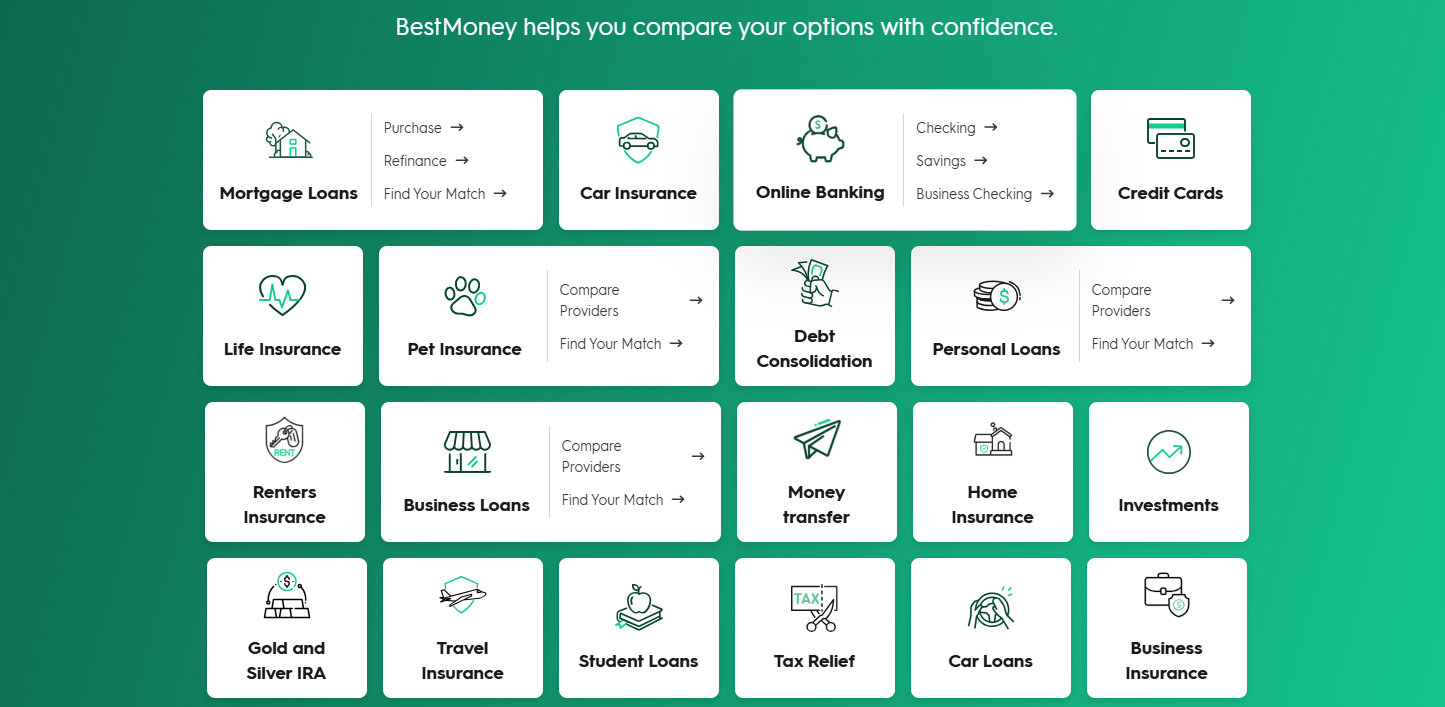
BestMoney’s biggest advantage is how quickly you can see your options, along with a clean interface and the ability to tailor results to your situation without signing in. A lot of comparison sites force you to either create an account or hand over a bunch of information first, and BestMoney generally doesn’t. Even for car insurance, which they do cover, they ask you a few questions and show you options without demanding your email up front.
The one catch on the insurance side is that the options they show don’t come with actual dollar amounts. They mostly point you out to other sites to see real pricing. So for insurance specifically, that’s a weakness, and you might want to lean on another site for that part. But for other products, BestMoney has a lot of depth, and that’s where it really shines.
From a data perspective, they have over 50 financial experts, 3K+ hours researched, and over 100 comparison tools, calculators, and more.
On transparency, they state that advertising compensation can influence placement and may affect how they score products, and that kind of honesty is valuable. On top of that, they cover categories a lot of competitors don’t, like tax relief and business finance, which is another point in their favor. Their individual lender reviews are shorter than NerdWallet’s, but ultimately if you are there to view options without needing to jump a bunch of hoops, BestMoney has you covered.
3. Policygenius

Policygenius is quite different as it acts as a licensed insurance broker with real agents you can talk to on the phone, which is a very different experience from a standard comparison site. They’ve been around since about 2014 and say they’ve helped over 30 million people shop for coverage and placed more than $200 billion in policies. They handle a range of insurance types, including life, home, auto, and disability.
So this isn’t really a site you browse so much as a place you go to work with a broker. If you want someone who’s going to dig in and try to find you a better deal, this could be exactly the thing for you.
At first glance, when you land on the Policygenius site, there isn’t much to poke around in. It’s pretty direct: enter your age and start comparing. You answer a few health and lifestyle questions and they generate quotes from top insurers. They do offer calculators to get a better estimate of what you might have to pay, but it wasn’t so readily visible as some of the other sites.
For that reason, if you’re just starting out and want to gauge where the market sits, Policygenius ranks below MoneyGeek, mainly due to user ease on the site itself. MoneyGeek is the better tool for insurance research, while Policygenius is built for going straight into your information and getting a call.
And compared to something like Policygenius, BestMoney and NerdWallet simply have far more to compare, from mortgages to personal loans, so it’s a much more varied platform.
4. Insure.com
Insure.com is fairly close to MoneyGeek in that it’s really only about insurance, so it’s similarly niched down.
They’ve been evaluating carriers for over 20 years, have 85+ partner companies, and over 15 insurance tools (less than BestMoney). Their editorial policy states that they don’t earn commissions for reviews or opinions, which is a real point in their favor, and their content is reviewed by licensed agents on staff.
They also have calculators and tools available, which is another reason it stacks up well against MoneyGeek. When you go in, you’re greeted with a similar set of questions to what you’d find on the other sites, and they have some genuinely useful tools, like a cost of living calculator that helps you understand what you’d expect to pay in a specific area. And like MoneyGeek, their calculators don’t require you to enter your email or personal details to get a result for your scenario.
One small difference worth mentioning: at first glance, MoneyGeek lists around five calculators on its main page, though you can probably find more by digging into subcategories. Insure.com lists all of its tools and calculators in one consolidated place, which gives it an advantage in terms of accessibility.
Which Comparison Site Should You Actually Use?

Like I said at the start, I’m a big believer in using different sites for different purposes, but you should still have your staples, the ones you come back to.
If you want a well-rounded platform, MoneyGeek isn’t really it, since it’s specific to insurance, but it’s still an excellent tool for what it does. Lean on MoneyGeek when insurance is the job, and reach for something more well-rounded like BestMoney or NerdWallet when you’re shopping for other financial products.
It’s also worth underlining why comparison sites matter in the first place. They can save you a lot of money, especially on something like car insurance or a mortgage. Just by comparing, you can save thousands of dollars over the life of a loan or policy.
I’d encourage everyone to use a comparison site, or a couple of them, and do the research before pulling the trigger on any specific company or lender. The half hour it takes is some of the best-paid time you’ll spend.