I got divorced in my 40s. I had three kids, but only one at home. It was a painful divorce, so for quite a while the idea of another relationship was the last thing on my mind. Eventually, however, pressure from friends and family, my high schooler’s busy schedule leaving him hardly ever at home, and loneliness brought dating to the forefront of my mind.
However, even though I made the leap to considering it, if you’d asked me back then what “dating again” was supposed to look like, I wouldn’t have had a good answer. I quickly discovered that most dating advice was aimed at people in their 20s.
I’ve since learned that the biggest difference in dating after divorce over 40 versus being single in your 20s comes down to emphasizing practical decisions. By the time you’re in your 40s or beyond, you probably have a well-established career, children, a home, a co-parenting schedule, strong preferences, and an ex you have to get along with.
Pacing, boundaries, and how much of the process you want to take on yourself are the issues you care most about.
Pacing: There’s No Right Timeline, But There Is a Wrong Question

The question most newly divorced individuals ask is how long to wait after divorce before you start dating. Six months? A year? Longer? The honest answer is that you’re asking the wrong question or relying on the wrong method to answer it. The calendar isn’t the best measure. The best evidence is whether you can sit across from a date and talk about your former marriage without crying into your salad. That’s a sign the story is still doing work in you that hasn’t finished.
The other thing nobody tells you about the difference between dating in your 20s and dating after divorce in your 40s: you’ve already built a life (job, mortgage, kids, ex, preferences). In your 20s, you can be more open to almost anything and don’t have all these other things to work around. At 40, a really important point is that you already know what you want. You know what you value, and you know what you won’t tolerate.
After I began dating again, I spent a lot of time asking and talking to prospective partners about subjects I had never brought up the first time around. Finances, religion, where they wanted to put down roots someday, kids, relationship with exes, and more. In my 20s, I probably would have said yes to most anything. In my 40s, I understood much better what can drive a couple apart.
Caution though. You can be tempted to move too fast when you think you know what you want. You don’t want to waste time. But remember, knowing what you want doesn’t mean you know the other person well enough. Those are two different kinds of knowing, and conflating them is one of the more common ways people get hurt the second time around.
Be Clear About What You Actually Want Before the First Date

“Someone kind” and “someone who makes me laugh” are great values to wish for, but on their own, they won’t keep a relationship together. The boundaries that actually save you time are the specific, logistical ones:
- Do you want more kids, or are you done?
- Are you open to relocating, or is that a hard no?
- How do you feel about dating someone who also has kids at home?
- How quickly do you want to define exclusivity, versus how long do you want to keep things casual?
That last question is extremely important. One of my dates started to seem just right for me. We were having a great time together and seeing each other fairly frequently. I made the mistake of assuming we weren’t seeing other people. One day, he brought up another woman he was also seeing. I was really surprised and disappointed. A lot of time and some anguish could have been avoided if we had discussed that early on.
It also helps to distinguish boundaries from preferences. A boundary is something you won’t compromise on – no more kids, no long-distance, no dating anyone who isn’t fully divorced yet. A preference is something you’d like but could move on from. Treating a preference like a boundary narrows your options for no good reason. Treating a boundary like a preference is how people end up compromising on things they said they wouldn’t and ending an otherwise good relationship.
One boundary that deserves its own mention: dating with a kid at home. My youngest son certainly affected my decision to date and how I proceeded. I probably waited too long because I was afraid of how it would affect him, and I wanted to be home at every moment for him. When I began dating, I only went out on nights or weekends when he was with his father. That worked well for me, but it’s certainly something you want to discuss on any first date you think you’ll continue seeing.
Another major point is discussing how you feel about introducing your kids to your new “friend.” Some prospective partners wanted to meet my children much earlier than I was comfortable with, and they felt somewhat rejected by that when I simply knew my son well and was trying to protect him. There was also a time when my date drove me home and insisted on walking me to the door, and my son, who was inside, ran to the door and came face-to-face with my date. My date felt the thing to do was to say hello and make a little small talk, and my son wanted nothing to do with him. My point is: keep your children apprised of your situation, make sure they’re comfortable, and follow their lead when it comes to meeting new suitors.
Going It Alone: What That Looks Like at This Stage

So… you’ve decided you’re ready to enter the dating world, but you’re wondering how. There are a few options.
Apps
You’ve no doubt heard of services such as eHarmony, DateMyAge and Match. There are many others. I sheepishly admit I tried most of them. They are particularly good for low-commitment browsing anytime you’d like and for volume. I’ve actually met several couples that really clicked through one of those services.
The downside is that you’re the one screening every profile, starting and sustaining many conversations, and figuring out who’s serious and who’s just looking for a romp in the sack. You also find yourself swiping out of habit, and then if you match with someone, having to decide whether to talk several times, text several times, or meet quickly – all with limited information and no one vetting anyone on your behalf.
Matching algorithms are optimized to keep you using the app, not necessarily to get you off it. And after a divorce, there’s an added layer: rebuilding a profile, figuring out how much of your life to disclose up front, and giving answers to strangers about your life and marriage because they always ask about that before you’ve even met them in person.
Organic routes
My mom was certainly an advocate of the old-fashioned way, as she called it – the organic routes. These include meeting someone through:
- A running club
- A church group
- A friend’s backyard barbecue
- Volunteering – food banks, animal shelters, political campaigns, disaster relief orgs.
- Adult sports leagues or fitness classes (pickleball is the hot topic these days)
- Alumni or professional networks – college alumni events, industry meetups, conferences.
- Hobby-based classes – cooking classes, wine tasting, pottery, dance lessons.
- Friends setting you up – the classic, but worth naming explicitly since it’s often the most trusted version of organic meeting at this age.
- Dog parks or neighborhood life – if applicable, genuinely common at this stage.
The tradeoff is volume and pace: you’re often limited to your own circle. It also takes a lot of effort to show up for these activities regularly, which isn’t always realistic with a full-time job and kids. It can be fun and successful, however, in many cases. I wouldn’t rule out organic routes.
Both paths put the entire workload on you: sourcing, screening, planning, showing up, and deciding whether it’s worth a second date – on top of everything else you’re managing.
Where Outside Help Changes the Experience

Matchmaking services shift the focus on who’s doing the searching, screening, and logistics. You’re still the one making the decision about your match, but you’re getting a lot of help with everything else. The first time I heard about this, I was extremely interested. The idea of not wasting good time swiping continually sounded like a real relief.
Instead of managing your own search, a dedicated matchmaker becomes familiar with your goals, your history, and your non-negotiables. Then they spend their time finding and vetting people for you. Sometimes, this includes a criminal record screening and/or video screenings, where your matchmaker meets a prospective match via video conference.
You may also have more than a matchmaker working for you. Some services may have a team consisting of the matchmaker, a client experience specialist, and dedicated relationship support. Some plan not just the person, but also the venue and scheduling, and offer real-time support if something feels off. Often, you debrief with your matchmaker after the date so they better understand what you’re looking for and how to set up the next date even better.
There’s obviously no guarantee that any method you use will lead to a long-term, successful relationship. What most matchmakers do guarantee is that they do much of the unglamorous groundwork for you, so you don’t have to do it yourself.
Not All Matchmaking Looks the Same
If you’re considering matchmaking, it’s worth knowing the category isn’t uniform – services differ in price, network size, and what’s included once you sign on.
Kelleher International, operating since 1986, is a boutique, ultra-luxury matchmaker. They openly claim to be very selective about who they let sign up. In their advertising materials, they say they are intentionally not for everybody. That’s reflected in the fact that national matchmaking with them reportedly starts around $15,000. They also give you a team that includes a matchmaker, a client liaison, and a scout. They stress that they are only looking for CEOs, celebrities, athletes, entrepreneurs, philanthropists, and other ‘elite’ individuals.
Three Day Rule, founded in 2013 by Talia Goldstein, reads as a more modern, lower-key entry point into matchmaking. It operates in several US metro markets and has a nationwide tier; third-party sources cite packages starting in the low $6,000s, though it doesn’t list pricing publicly. Clients are paired with a personal matchmaker and coach, but the company’s public materials don’t detail whether full date-planning or background screening are part of a standard package. I was disappointed by the limited information they provide on their website compared to other companies.
It’s Just Lunch, running since 1991, is one of the longest-standing names in the category and has coordinated a large volume of introductions over the decades. Matchmakers there hand-select introductions and arrange restaurant reservations, with feedback collected after each date – but the company is explicit that it doesn’t run background checks on its members, framing that as avoiding a false sense of security rather than as a gap. They also don’t publish prices.
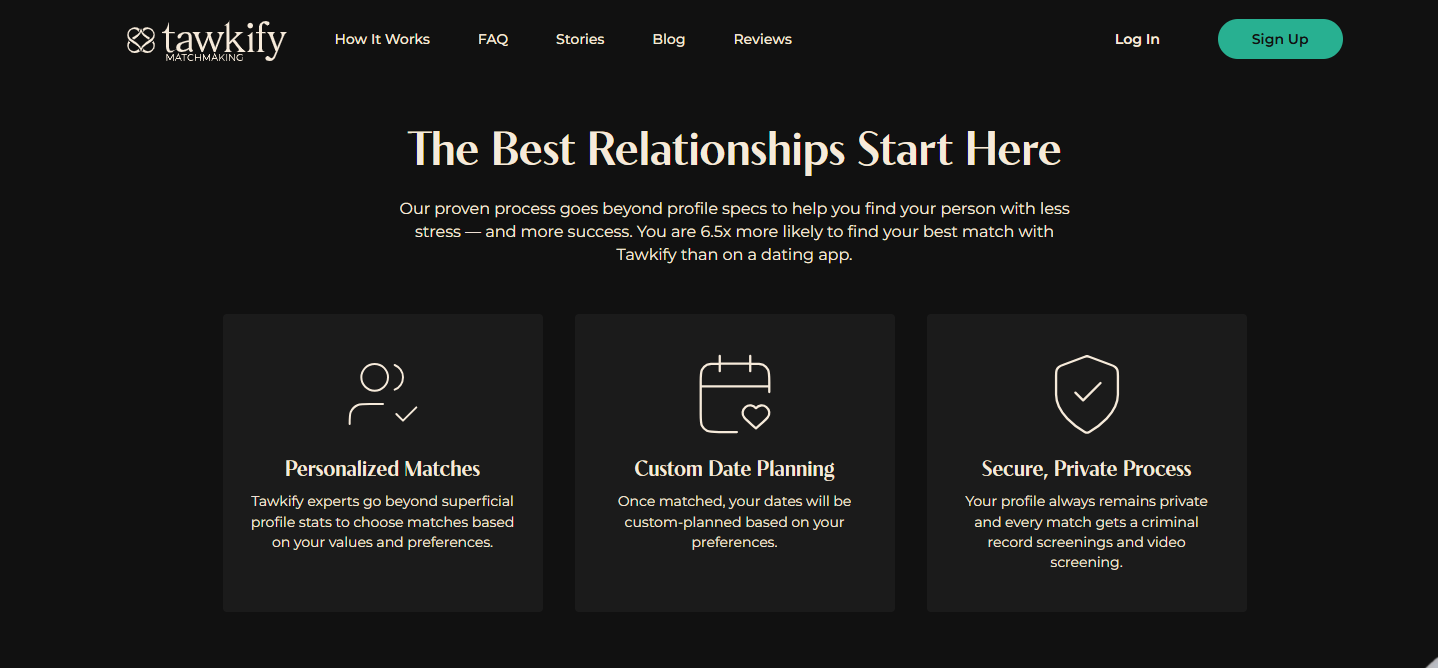
Tawkify sits in the middle of matchmakers’ price range. Its model is built around a few specific commitments: a dedicated matchmaker rather than a shared pool, a published network it positions as the largest in the category, criminal record and video screening on every proposed match, and dates that are fully planned – venue, scheduling, day-of support – rather than left to the two people to figure everything out on their own. After each date, you debrief with your matchmaker, and that feedback shapes who they introduce to you next, which is a structured loop most self-directed dating doesn’t have.
There’s little that makes any one option objectively “better” than another – it depends on what you’re looking for. But “hiring a matchmaker” isn’t a single, standardized experience, and it’s worth understanding the differences before committing real money.
What “Ready” Actually Looks Like

If I had to boil it down, while readiness after divorce in your 40s includes feeling you’re ready, it’s more a short list of things you’ve actually worked out:
- You can talk about your marriage without it hijacking the conversation
- You know your non-negotiables well enough to state them in one sentence
- You’ve decided, realistically, how much of the search you want to do yourself
- You’ve thought through how dating fits around your kids, not just around your calendar
There are no guarantees about who you’ll meet or how it will go. But it’s the difference between dating on purpose and just hoping something works out.