By January, that pretty Christmas wreath is crunchy and brown, and your porch looks like you gave up. I once hung real magnolia leaves in December, and they’d rotted to black mush by New Year’s, stuck to my door clear into February because I couldn’t stand to look at the empty nail. That was the winter I quit buying anything that couldn’t take a hard freeze.
Good winter porch decor swaps holiday styling for pieces built to survive actual winter. The birch branch bundle wreath runs about $25 to $40 and looks better wet than dry. A galvanized metal hanging door bucket, $15 to $25, holds pinecones without cracking in a freeze. Add a faux cedar garland framing the door for $20 to $35, and your porch looks intentional eleven weeks from now, not eleven days.

The Door
1. Birch Branch Bundle Wreath
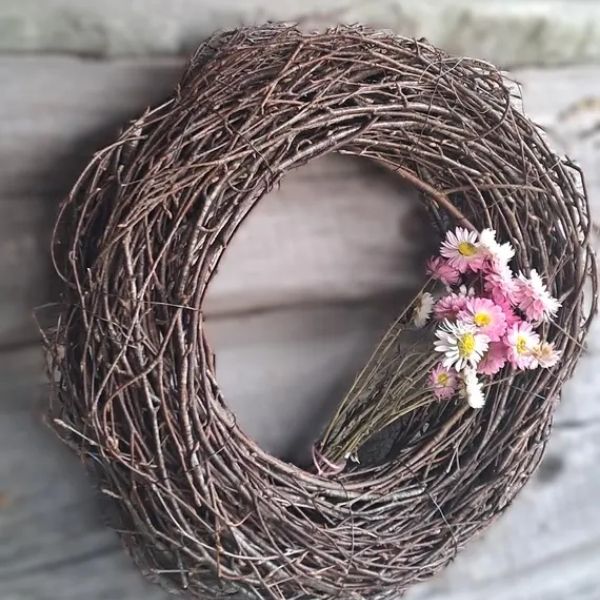
Birch reads as winter without reading as Christmas, which is exactly what you want on a door you plan to leave alone until March. A faux or dried birch branch bundle wreath runs about $25 to $40 at Target or Michaels, and it holds its shape through hard freezes because there’s no moisture left in the wood to expand and split.
The only thing that wrecks birch is standing water. Hang it high enough on the door that snow slides off instead of piling into the bottom curve, and knock it clean after a wet storm.
One per front door is plenty. How long anything on this list lasts depends on how exposed your porch is, so a covered entry will buy you several seasons where a west-facing open porch may get two.
2. Preserved Magnolia Leaf Swag With Outdoor-Rated Ribbon
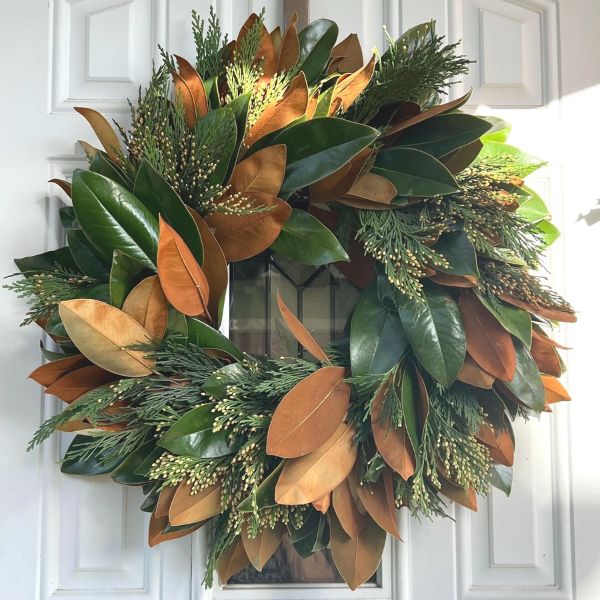
A preserved magnolia leaf swag costs about $15 to $30 and solves the storm door problem, because it lies flatter than a wreath and doesn’t get crushed every time the door swings. The leaves fade and darken slowly over two or three seasons in direct sun, which honestly reads as intentional.
Ribbon is where most people go wrong. Satin soaks up melting snow, freezes stiff, then unravels into a sad gray string. Outdoor-rated wired burlap or weatherproof poly ribbon runs closer to $6 a roll at Michaels and keeps its bow shape through wind.
I know this because one late January I finally pulled down a satin bow that had frozen solid to my door and came off in pieces.
3. Faux Cedar or Pine Garland Framing the Door
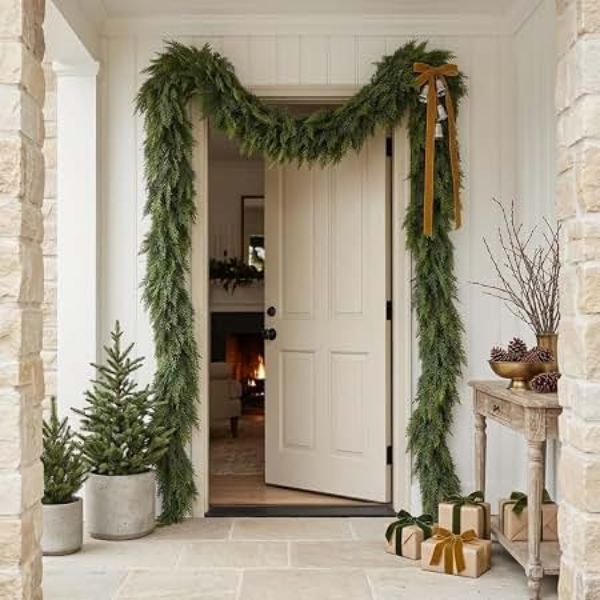
Guests notice a framed door before they notice what’s hanging on it. Two 6-foot lengths of faux cedar or faux pine garland will frame a standard door, and each length comes in around $20 to $35 at Lowe’s or Michaels. Budget $40 to $70 for the pair, or add a third length if your frame is tall.
Secure it with black zip ties looped over small cup hooks or finish nails. Outdoor tape quits below freezing and you’ll be re-hanging it in a snowstorm.
PVC needle garland stays flexible in cold and doesn’t shed the way a real cedar rope does by week two. Skip anything with fake snow flocking, which streaks white down your door casing in the first rain.
4. An Over-the-Door Metal Wreath Hanger
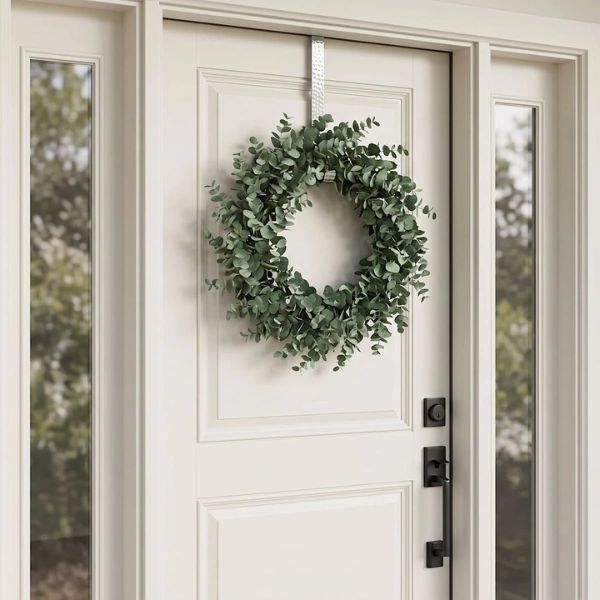
Adhesive hooks fail in cold weather. The adhesive turns brittle, the door surface stays damp, and your $35 wreath ends up face down in the snow.
A metal over-the-door wreath hanger totals about $10 to $18 at Walmart or Amazon, hooks over the top edge of the door, and leaves no residue or holes. If you have a steel entry door, a magnetic wreath hanger in that same price range holds firm through wind.
Once you switch to a hook-style hanger, adhesive hooks stop being worth the hassle.
One fit note: if you have a storm door, measure the gap first. Anything more than three inches deep will scrape every single time you open it.
5. A Galvanized Metal Hanging Door Bucket
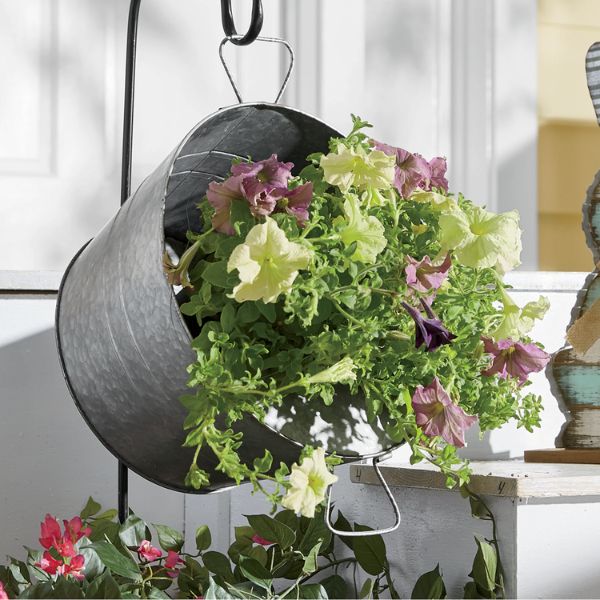
Galvanized metal is the one material here that truly does not care what winter does to it. A hanging galvanized bucket or wall pocket costs about $15 to $25 at Walmart, Hobby Lobby, or Amazon, and it’s a good swap if you’re simply tired of wreaths.
Fill it with faux cedar tips, dried seed pods, and a handful of pinecones off the ground, which adds nothing to the cost. Metal won’t crack when the water inside it freezes and expands, unlike a ceramic wall planter, which will split down the side by February.
Punch or drill a drainage hole in the bottom if it doesn’t have one. Otherwise you get a solid block of ice sitting in it until spring.
The Steps and Railing
6. Galvanized Buckets of Birch Logs Staggered Up the Steps
Cold doesn’t bother galvanized metal at all, which is what makes it such an easy choice for step displays instead of just a door. Buckets cost around $15 to $25 each at Target, Hobby Lobby, or Tractor Supply, and you’ll want at least two, one per side of the steps, or three staggered up a longer run.
Fill them with white birch logs, about $10 to $20 a bundle at Michaels, or free from a firewood pile if you know someone with a woodstove. Add a handful of pinecones on top. My grandkids filled two buckets with pinecones one Saturday afternoon and were prouder of that porch than I was.
Tip the buckets out after an ice storm so water doesn’t freeze solid inside.
7. Battery String Lights Rated IP44 or Higher on the Railing
When lights die in January, it’s almost never the bulbs. It’s water in the battery box or alkaline batteries quitting in single digits.
Buy string lights specifically rated IP44 or higher, typically $20 to $35 at Amazon or Lowe’s. Brightown and Twinkle Star both make weather-rated battery sets with a built-in six-hours-on timer, which matters when it’s dark at 4:30 and you’re not going outside to flip a switch. Two 33-foot strands cover most standard railings.
Use lithium AA batteries instead of alkaline. They hold voltage far better below freezing, and you’ll get most of the season out of one set instead of swapping every three weeks. Store the strands dry indoors in spring and they’ll give you several winters.
8. Black UV-Resistant Zip Ties for Anything Attached to the Rail
Everything on a railing needs to be fastened, because wind will take it otherwise. Standard white zip ties go brittle in cold sun and snap by February, usually overnight, usually into the neighbor’s yard.
Black UV-resistant ties run about $6 to $10 for a 100-pack at Home Depot, Harbor Freight, or Amazon, and they hold through a full winter without failing. Rubber-coated garden wire runs closer to $5 and works well on anything you want to reposition.
It takes only a few minutes to work your way down a railing securing lights and greenery, and none of it budges again until spring.
Trim the tail ends flush so they don’t catch coat sleeves.
9. Weight the Bottom of Every Container With Sand or Pea Gravel
Wind is what nobody plans for, and an empty metal bucket full of light birch logs will tip and clatter down the steps at two in the morning. A bag of play sand or paver base is about $5 to $8 at Lowe’s or Home Depot and fills the bottom third of two or three buckets.
Sand is the better choice on a porch. Gravel works, but sand won’t roll away if a container gets knocked over. Neither one cracks, freezes into a problem, or costs anything to replace.
Fill to about a third, tamp it down, then set your logs or branches in on top. The whole fix comes in under $10 and keeps your entire step display standing through a windy stretch.
10. Rubber Stair Treads on the Steps That Take the Salt
Your steps take the hardest wear on the whole porch: boots, ice melt, snowmelt refreezing overnight. Rubber or PVC stair treads take that abuse instead of your paint or wood.
A set of four costs around $25 to $40 at Amazon, Walmart, or Home Depot. Ottomanson and Envelor both make outdoor-rated versions in plain black or a low-pile weave that reads as finished rather than utilitarian. Measure your tread depth first, because 8-inch and 10-inch versions are not interchangeable.
Adhesive backing does not hold in freezing temperatures. Use exterior-grade screws at the corners or outdoor double-sided tape applied in fall while it’s still warm. Plan on replacing them every two or three seasons once the salt has done its work.
Planters and Containers
11. Replace Cracked Ceramic With Resin or Fiberglass Planters
I lost a favorite glazed terra cotta planter to its first Kansas City winter. Wet soil froze, expanded, and split it clean down one side sometime in January. I didn’t even notice until the thaw.
That’s what ceramic and terra cotta do outdoors in freezing weather, no matter how much you paid. Resin and fiberglass planters flex instead of cracking, and the good ones read as stone from six feet away.
Expect to pay about $30 to $60 each at Lowe’s or Home Depot, and buy two so the door has symmetry. Look at the base before you buy: a wide, heavy bottom stays put in wind, and open drainage holes keep meltwater from pooling and freezing inside.
They last years, which brings the real cost per season down to almost nothing.
12. A UV-Rated Faux Boxwood Topiary in a Weighted Pot
A faux boxwood spiral or cone gives you green all winter with no watering, no browning, and no worry about a hard freeze. Target and Amazon both carry them, typically $25 to $45, and a pair flanking the door does more for the porch than any wreath.
The word to check is UV-rated. Cheap faux greenery that isn’t UV-treated goes chalky and yellow-gray after one season of sun, even weak winter sun. UV-rated versions hold their color for several years.
Set the topiary in a resin pot and pack sand around the base so wind doesn’t tip it. If you get freezing rain, the leaves ice over and thaw out fine. Heavy wet snow is what bends stems, so knock it off with a broom.
13. One Live Dwarf Evergreen That Actually Survives the Season
If you want something living out there, skip anything that needs coddling and buy a dwarf Alberta spruce or a winterberry holly in a nursery pot. Lowe’s and Home Depot carry them, and they’re about $25 to $40, both hardy enough to sit outside all winter in a container.
The catch is the pot. Roots in a container freeze harder than roots in the ground, so use a planter at least 16 inches wide, and water on any day the temperature climbs above freezing. Dry roots kill more container evergreens than cold does.
Come spring you plant it in the yard and buy a new one next November, or keep it potted for a second winter. Either way, it’s the only item here that improves with age instead of fading.
14. Red Twig Dogwood Bundles and a Bucket of Pinecones
Red twig dogwood is the single best value in a winter container. Bare red stems against snow give you color that no faux stem replicates, and a bundle runs you about $10 to $20 at a local nursery, a garden center, or occasionally Trader Joe’s in December.
Stand five to seven stems tall in the center of a pot and mound pinecones around the base to hide the mechanics. The stems freeze solid and stay upright, though the red fades toward brown by late February, so plan to replace them next season.
Pinecones make free filler, and they last indefinitely because dry pinecones simply do not care about weather.
15. Lift Every Pot Off the Concrete With Pot Feet
Ice welds planters to a porch floor. Water runs out the drainage hole, pools underneath, freezes, and now the pot is stuck, the bottom is holding standing water, and come March you’re chipping at it with a screwdriver.
A set of three pot feet costs around $10 to $18 at Home Depot, or use two bricks you already have, which costs nothing. Either raises the base a half inch so meltwater drains and air moves underneath.
This is a five-minute fix that adds years to a planter’s life, especially the resin ones.
16. Drop-In Nursery Pot Liners So You Can Swap Fills Without Hauling
Swapping out a planter in January means moving something heavy and half-frozen, which is why most people just leave the sad December arrangement up through March.
The fix is a plastic nursery pot that fits inside your decorative planter. Build the arrangement in the liner, then lift the whole insert out and drop in a new one when the greenery browns. Nursery pots cost around $5 to $10 each at a garden center, and plenty of places hand them over free if you ask.
Buy two liners per planter so one is always ready. Plastic handles freezing fine and lasts several seasons before it gets brittle. It turns a 40-pound project into a 30-second lift, which is the difference between refreshing your porch and ignoring it.
Lighting for Early Darkness
17. Change the Bulb Before You Buy a Single Decorative Light
Before you spend anything on lanterns or strands, swap the bulb in the fixture you already have. A dusk-to-dawn LED turns itself on when the light drops and off at sunrise, so nobody is climbing dark steps at 4:45 in January.
Feit and Sunco sell them for about $10 to $18 for a two-pack at Home Depot or Amazon. Get warm white, 2700K to 3000K. The bluish daylight versions make a snowy porch look like a parking lot at midnight.
Check that the packaging says damp or wet location rated, which nearly all of them do, and the bulb will run through freezing temps and blowing snow without any attention from you. LEDs actually hold up better in cold weather than they do in August heat.
18. Two Solar Lanterns, One on Each Side of the Door
Two solar lanterns flanking the door do more for a winter porch after dark than any amount of greenery does in daylight. Buy them in pairs. One lantern alone just looks like something got knocked over.
Target, Lowe’s, and Amazon carry metal-and-glass solar lanterns with a flameless LED candle inside, priced around $15 to $25 each, so a pair sets you back $30 to $50. The panel charges fine in weak winter sun, though after a stretch of gray days you’ll get four or five hours of glow instead of eight.
Metal and tempered glass handle freezing with no trouble at all. What ruins them is water pooling in the base and then turning to ice, so set them on the porch floor under cover rather than out on an open step where snow piles up.
19. Flameless Pillar Candles Inside Glass Hurricanes
A set of three battery-operated flameless pillar candles sets you back about $20 to $35, and dropped into glass hurricanes they read as real flame from the sidewalk. Luminara and the Costco seasonal sets have a convincing flicker. The cheap ones pulse like a smoke detector with a low battery.
There’s no wax to crack, sag, or melt, so freezing temperatures do nothing to them at all. They’ll sit out from November through March.
When my kids were little I put real candles in hurricanes on the porch one Christmas Eve and spent the whole evening walking out to check on them. Batteries fixed that for good. Use the built-in timer so they come on at dusk for six hours, and plan on fresh batteries around the first of February.
Your Porch Can Make It To Spring
That black, mushy magnolia stuck to my door taught me something. Winter decor has to actually be built for winter, not just borrowed from December and left to fend for itself. You don’t have to choose between a bare nail and a mess you’re embarrassed to walk past for eleven weeks.
Start with the birch branch bundle wreath if you want something that looks better with a little frost on it. Try the galvanized metal hanging door bucket filled with pinecones if you need a quick swap that won’t crack when temperatures drop. Or add battery string lights rated IP44 or higher along the railing if you want your porch to feel warm even when it’s fifteen degrees out. Pick one, get it done this weekend, and let your porch actually hold up this time.