Spice organization falls apart the moment you need oregano mid-recipe and find three jars of cumin instead. You know the drill: sauce simmering, one hand digging through a cabinet where jars go to hide, the other hand holding a phone open to a recipe that assumed you’d already have this figured out. I once bought cinnamon at the store while two half-full jars sat behind the paprika at home, because I genuinely couldn’t see what I owned. The Saturday I finally hauled every jar onto the kitchen table, I counted forty-one bottles, and eleven of them were flat enough to toss.
The Duplicate Check gets every jar out where you can see it, and the Sniff-and-Color Check shows what’s worth keeping. Sort what’s left into keep, replace, and retire piles, pick a system, and every jar lands in a spot your hand already knows.

Start here
1. The Duplicate Check
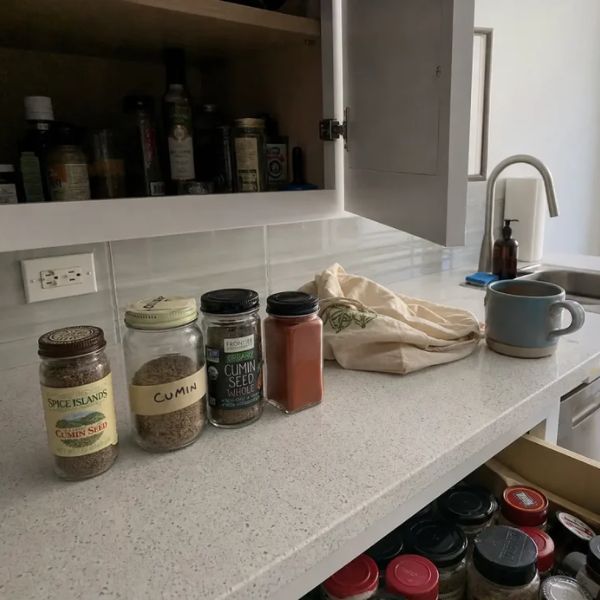
Pull every spice jar in the house onto the counter or kitchen table. Not the ones in the cabinet, all of them, including the two in the pantry and the one that migrated to the camping bin. Group matching spices together as you go.
This is where I found three jars of cumin. I had bought the second one mid-recipe because I couldn’t see the first, and the third one because I’d forgotten the second. Nothing was wasted exactly, but I’d paid three times for one spice.
This one costs $0 and takes about 20 minutes, plus enough counter space for every jar.
Why it keeps working past day one: once the duplicates are sitting side by side, you remember them in the spice aisle, which is the only place that memory matters.
2. Combine the Duplicates Into One Jar
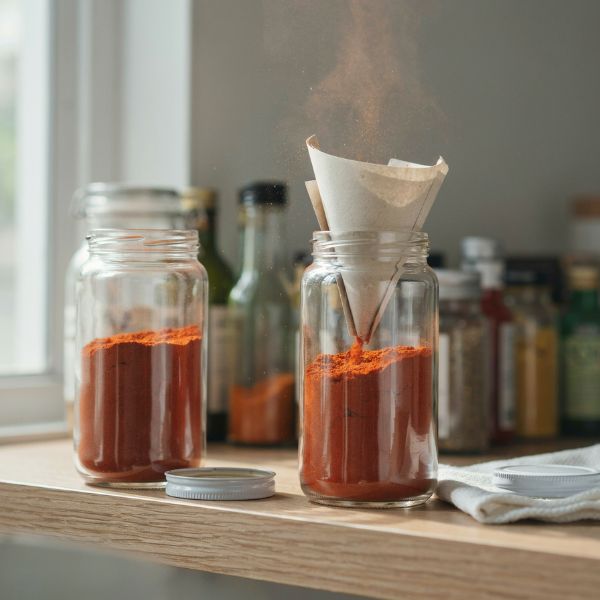
Two half-full jars of paprika take up twice the shelf space and hide twice as well. Pour the older one into the newer one, as long as both are the same spice and both still smell like something.
Use a small funnel if you own one. If not, roll a piece of printer paper into a cone and pinch the tip, which works just as well and costs nothing. Wipe the rim before the lid goes back on so it seals cleanly.
Cost: $0. Expect to free up three to six slots in an average cabinet.
The shelf stays readable after this because you’re storing one jar per spice, which is the whole point of a spice cabinet organization reset.
3. The Sniff-and-Color Check
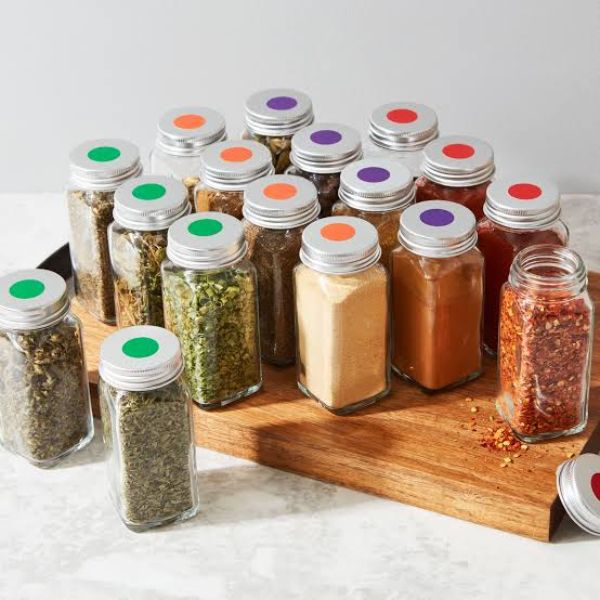
Your nose is a better tool here than any date printed on the bottom of the jar. Open each duplicate-free jar, hold it a few inches away, and smell. Then tip it toward the light and look at the color.
A faint aroma and dull, grayish color mean the flavor has faded. Spices don’t spoil in a way that will make anyone sick; they just stop doing their job, so you end up doubling the recipe amount and still tasting nothing.
General guidance, not exact dates: ground spices hold good flavor roughly 2 to 3 years, whole spices roughly 3 to 4, and dried herbs sit on the shorter end.
$0 spent, and you replace only what’s actually flat instead of clearing the shelf out of guilt.
4. The Clump Test for Jars That Lived Near the Stove
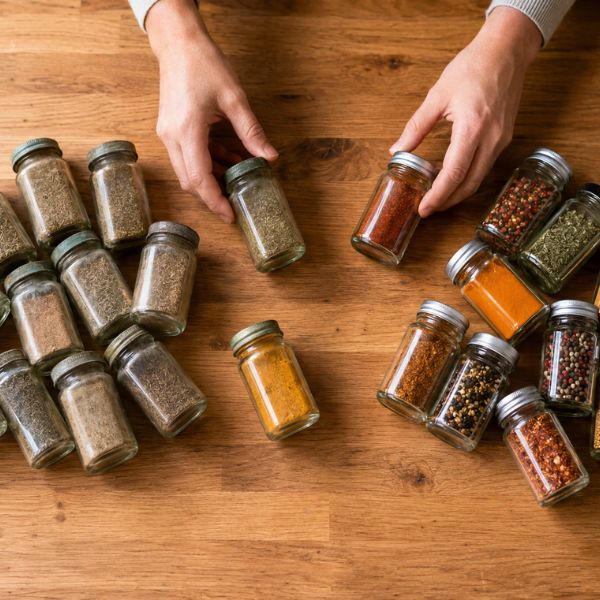
If the garlic powder has set up like a brick and the onion powder rattles in one solid chunk, moisture and heat got in. That usually means the jar sat above the stove or next to the dishwasher vent, where steam rises every single day.
Break a clump apart with a dry fork. If it crumbles and still smells sharp, it’s fine to keep. If it stays cemented or smells like dust, it goes.
Cost: $0, nothing to buy.
The lasting fix is where the jar goes back, not what you do to it today. Pick any spot away from direct heat and steam, and the clumping largely stops on its own.
5. Sort Into Keep, Replace, and Retire Piles
Three piles on the table, no agonizing over any single jar. Keep is anything that smells strong. Replace is anything flat that you genuinely cook with. Retire is the flat stuff you bought for one recipe in 2019 and never opened again.
Be honest about that third pile. Nobody needs to keep ground mace on hand out of principle.
Cost: $0. What you need: the jars already sorted from items 1 through 4, plus 10 minutes.
Only the Replace pile goes on the shopping list. That’s the difference between a reset that trims your spending and one that quietly adds $40 of new jars to the cart.
6. Wipe the Shelf While It’s Empty
Nothing is going to get this shelf this empty again for months, so clean it now. Spilled turmeric, sticky honey-powder rings, and a surprising amount of loose peppercorns are usually waiting under where the jars sat.
A spray bottle from Dollar Tree runs $1.25 and a gallon of white vinegar is roughly $4 at Walmart. Mix equal parts vinegar and warm water for a bottle that lasts months. A name-brand all-purpose spray costs $4 to $6 per bottle, so the homemade version is a few cents per fill.
Works on laminate shelving, shelf liner, and painted wood. On unsealed wood or stone, skip the vinegar and use a drop of dish soap in warm water instead. Dry the shelf fully before the jars go back.
7. An Inventory List Inside the Cabinet Door
Write down what survived the sort. An index card and a pen you already own costs $0. If you’d rather have something you can rewrite, a small notepad at Dollar Tree is $1.25, and a pack of Command strips at Target runs $5 if you don’t want tape residue on the door.
Tape it inside the cabinet door at eye level, list the spices alphabetically, and put a check next to anything running low.
If you find yourself rebuilding the same taco or chili mix from scratch every month, our Homemade Chili Seasoning ratio post covers that separately so you can stock the few jars it actually calls for.
You check the list before you shop instead of standing in the aisle guessing.
8. Snap a Photo of the Open Cabinet Before You Shop
Open the cabinet door, hold your phone back far enough to catch every row, and take one picture. Retake it whenever you do a real reset, which for most kitchens is a couple of times a year.
Cost: $0, using a phone you already carry.
This backs up the written list, since labels in a photo don’t lie about how much is actually left in the jar. Checking the photo before you shop takes about nine seconds and keeps a fourth jar of the same spice out of your cart.
Mark it as a favorite so it doesn’t get buried under soccer photos by Tuesday.
Pick a system
9. By Frequency: The Jars You Reach For Go Where Your Hand Goes First
Pull the five or six jars you genuinely touch every week, the salt and pepper and garlic powder and cinnamon and whatever blend you dump into everything, and give them the front of the shelf at eye level while the rest moves behind them or up a level. Rearranging costs $0.
I remember those weeknights when the kids were small, and dinner had about eleven minutes of runway. I grabbed the same three jars over and over, and they were never in the same place twice, because I shoved them back wherever there happened to be a gap.
Why it holds up past day one: any system fails when putting a jar away is harder than grabbing it. Frequency sorting puts the easiest spot exactly where your hand already goes, so the jars put themselves back.
10. Alphabetical, If More Than One Person Cooks
Alphabetical order has a reputation for being fussy, and in a one-cook kitchen it usually is. In a kitchen where your husband unloads the groceries, or where grandkids are old enough to be handed a jar of cinnamon and told to dump, it earns its keep. Nobody has to ask where anything lives. $0.
Don’t chase perfect order. Sort by first letter and stop there. Cardamom in front of Cumin does not matter, and the day you start caring is the day the system gets abandoned.
It survives because it does not depend on you. Anyone who knows the alphabet can return a jar to the right place without being trained first, which is exactly why duplicate jars stop multiplying.
11. A Baking Spice Zone, Built Before Baking Season Starts
Cinnamon, nutmeg, ginger, cloves, allspice, and cream of tartar have almost nothing to do with your dinner spices, so stop storing them together. Pull them into one group of their own. $0 if you just cluster them, or about $1.50 for a small plastic bin at Dollar Tree, $4 to $6 for a sturdier one at Target or Walmart if you want to lift them out as a unit.
Holiday baking is the moment this group earns its keep. Standing at the counter hunting four separate jars while a recipe is already in progress is exactly the scramble this zone prevents.
One bin comes down, the baking happens, the bin goes back. That single motion is why the zone is still intact in January instead of scattered across three shelves again.
12. Keep Blends Separate From Single Spices
Your seasoning blends and your single spices do two different jobs. Blends are the shortcut, the thing you shake over chicken or potatoes on a Tuesday. Single spices are what a recipe calls for by name. Mixing them together means digging past a steak rub and a lemon pepper to find the thyme. $0.
Give blends their own short row, front and low, since they get grabbed casually. Single spices go behind or above them, sorted however you chose in the last few ideas.
Blends are also the biggest duplicate offender in most kitchens, because the labels look alike and the names blur together. Keeping them in one visible row means you can count them at a glance.
13. Sort by Jar Height Inside Whatever System You Pick
Tall jars behind short ones.
That’s the whole rule, and following it costs $0. Most spice cabinets are a mix of store jars, refilled jars, little tins, and one enormous warehouse-club container of cinnamon. When the tall ones land up front, they hide two full rows behind them, and that hidden back row is where the duplicates breed.
Apply this inside each group rather than across the whole cabinet. In your baking cluster, short jars in front. In your taco cluster, same thing. The system you chose still holds; you’ve just made every label readable without moving anything.
The payoff shows up at the worst moment, when you’re mid-recipe with one free hand. You see what’s there instead of excavating for it.
14. The Hybrid: Everyday Jars Up Front, Alphabetical Behind
Forty jars is too many to alphabetize and too many to sort purely by habit. Combine the two. The eight to ten you use weekly get the front row by frequency, and everything behind them runs in alphabetical order. $0, and it takes about ten minutes once the duplicate check is done.
This is the version I’d point most people toward, because it fixes both problems at once. Your weeknight cooking stays fast, and the once-a-year jars, the fennel seed, the ground cardamom, the smoked paprika you bought for one recipe, still have a findable address.
The back row is the part that normally goes feral. Giving it a rule is what keeps you from buying a second allspice next November.
15. Decide the Rule Out Loud, Then Live With It a Week
Before you commit to any of these systems, run it for one week and see whether the jars come back to where they belong on their own. If they don’t, the system is wrong for your kitchen, not the other way around. $0 to test, and $0 to switch, which is the nice part about sorting instead of buying.
Say the rule out loud to whoever else cooks or unloads groceries. “Baking spices are in the bin, everything else is alphabetical.” My husband does most of the grocery unloading these days, and he followed the new order within a few days simply because I told him what it was instead of waiting for him to figure it out.
A system only you know about holds right up until the week you’re too busy to think about it, which is exactly the week it needs to run without you.
Pick a spot
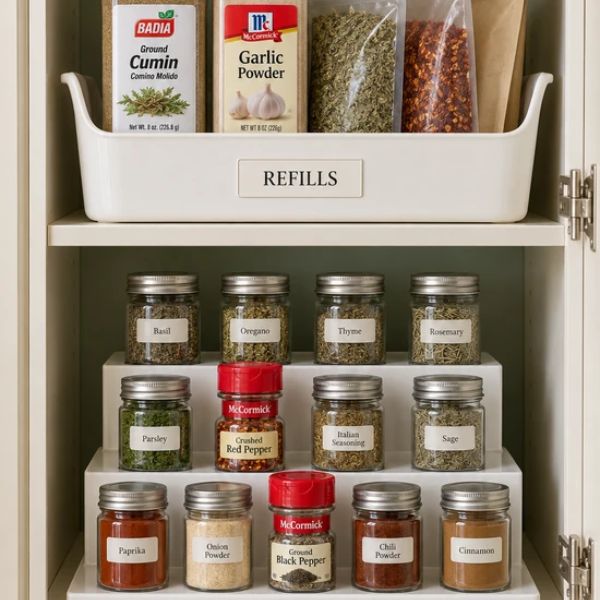
16. Cabinet: A Tiered Riser
Grandkids are the reason I finally bought one. During a holiday baking afternoon, the two of them kept asking me which jar was the cinnamon because all they could see was the front row, and the back row might as well have been in another house.
A basic plastic riser at Dollar Tree costs $1.25 to $5. A sturdier one from Target or Amazon runs $12 to $18. Or spend $0 and set a small sturdy box or an overturned mixing bowl under the back jars as a step. Call it spice rack organization without the rack.
What you need first: a tape measure. Check cabinet depth and the height between shelves before you buy anything, because a riser that doesn’t fit becomes clutter of its own.
It keeps working because the back row never disappears again. You see every label without unloading the shelf.
17. Cabinet: A Turntable
One spin brings the oregano to you instead of pulling out five jars to reach the sixth. For a corner cabinet or a deep shelf, this is the single easiest piece of spice cabinet organization you can add in under five minutes.
Dollar Tree carries turntables for $5. A basic plastic one at Target or Walmart costs $8 to $12, and a sturdier branded version from Copco or the Container Store goes for about $15 to $20. One 9 to 11-inch turntable holds roughly a dozen standard jars.
Measure the shelf and the door opening first. A turntable that rubs the door frame gets abandoned by week two.
More dollar store fixes like this one are in our [12 Dollar Tree Kitchen Hacks That Actually Fix the Chaos].
18. Cabinet: A Pull-Out Bin for the Deep Back Shelf
When the cabinet is deeper than your arm is comfortable reaching, a bin turns that back space into something you can actually use. You grab the handle, slide the whole thing forward, take what you need, and push it back.
Clear shoebox-size bins at Dollar Tree are $1.25 to $5, and a sturdier Sterilite or mDesign bin at Target costs $5 to $10. A shoebox or a cut-down cardboard box does the same job for $0 until you decide the system is sticking.
One bin is usually enough for the overflow jars. The real upside shows up at cleaning time, since spilled paprika lands in a bin you can rinse at the sink instead of on a shelf you have to empty first.
19. Drawer: Jars Lying Down, Labels Facing Up
Jars laid flat with the labels facing up give you something a cabinet never will: the entire collection readable in one glance, no tilting, no digging. Good spice drawer organization is mostly this one move.
Cost is $0 if the drawer and the jars already exist. If the labels are turned the wrong way, masking tape and a marker you already own fix it, or spend about $1.25 on tape at Dollar Tree.
What you need: a shallow drawer, ideally one under four inches deep, so jars lie in a single layer. Stacking defeats the whole point.
It holds up because nothing has to be moved to see anything. For the rest of the drawer, see [How to Organize Kitchen Drawers].
20. Drawer: A Utensil Tray as a Divider
If your jars roll to the back every time the drawer closes, the fix is probably already in your kitchen. That spare utensil tray from the drawer you reorganized last spring holds standard spice jars beautifully, since the compartments are close to the right width.
Repurposing one costs $0. A plain Dollar Tree tray is $1.25 to $5, and a drawer organizer set from Target runs $10 to $15. Match the compartment width to the bottom of your jars, roughly an inch and three-quarters for most standard bottles.
Add a strip of non-slip shelf liner underneath, about $3 to $5 at Walmart, and the tray itself stops sliding too. Jars stay in their lanes, which is what makes the layout survive past the first week.
21. Wall: Magnetic Tins or a Narrow Shelf
No cabinet space left to give? Go vertical. A set of a dozen empty labelable magnetic tins on Amazon runs $15 to $25, a magnetic strip or bar is about $8 to $15, and a narrow floating shelf from Target or IKEA runs $10 to $20.
Mount it near the stove, not directly above it. Steam and heat dull flavor faster than time does, so a few feet of distance protects what you just organized.
Measure your wall space and count your jars before ordering tins, since twelve is rarely enough for a cook who bakes. For spice organization in a small space, this is often the only option that doesn’t borrow room from something else, and the tins wipe clean with a damp cloth.
22. Counter: A Small Tray for the Daily Five
Some jars never make it back into the cabinet anyway. Salt, pepper, garlic powder, an everyday blend, and one more that’s yours. Give those five a tray and stop pretending they live anywhere else.
A plain tray at Dollar Tree is $1.25 to $5. A wood or metal one at Target or Walmart typically costs $8 to $15. A small plate or an old baking pan you already have works for $0.
The practical win is cleanup: spilled cumin lands on a tray you lift and rinse instead of a counter you scrub around appliances.
Hold the line at five. Six becomes nine, becomes a counter you can’t wipe down.
That Cabinet Won’t Hide Anything From You Again
No more buying cinnamon you already own or digging through three jars of cumin while your sauce burns on the stove. That cabinet got messy over years, so give yourself permission to fix it one honest decision at a time.
Pick the fixes that match your cabinet and your cooking. You don’t need all 22 today. Pull the jars onto the counter tonight while the water comes to a boil, and start counting what you find.