That pile by the door never seems to shrink, no matter how many bins you add, and the one shoe you actually need is always buried on the bottom. I used to keep adding more bins and more hooks until my entryway looked like a shoe store exploded, and nothing ever actually got put away.
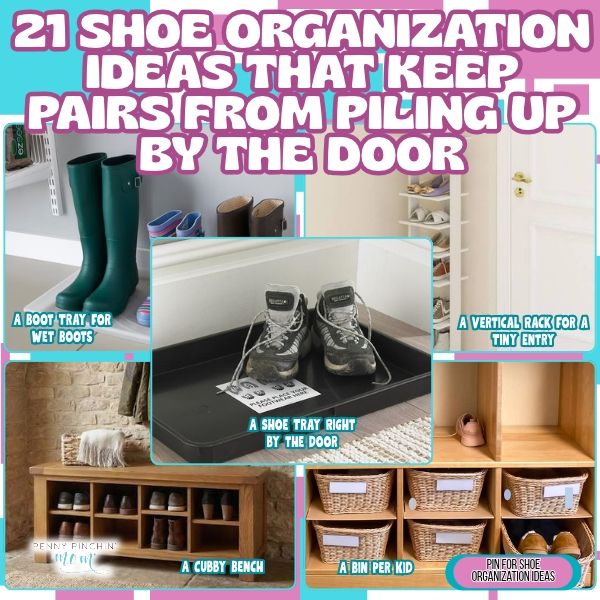
These shoe organization ideas fix that with one landing spot that works. A boot tray catches the drip before snow boots soak the floor. A shoe tray right by the door gives everyone one obvious spot to toe off shoes, and a bin per kid means nobody digs through everyone else’s pairs looking for their own.
At the Door
1. A Boot Tray for Wet Boots
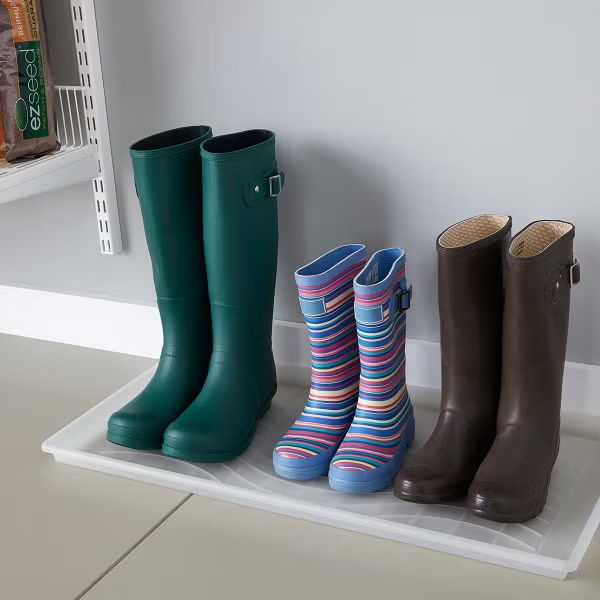
Wet boots need somewhere to drip that isn’t your hardwood. Check what’s already in the house first: an old cafeteria tray, a plastic dish pan, or the drip pan from under a washer all work for $0. Target and Walmart both carry molded boot trays for about $15 to $30, and prices swing by region, so treat every number here as a ballpark.
A 2-foot tray holds four to six pairs. A family of five usually needs two, one on each side of the door.
Get molded plastic with a raised lip rather than a flat mat, so melted snow pools in the tray instead of running onto the floor. This holds up past the first week because dripping boots have no other acceptable place to land, and everyone learns that fast.
2. A Shoe Tray Right by the Door
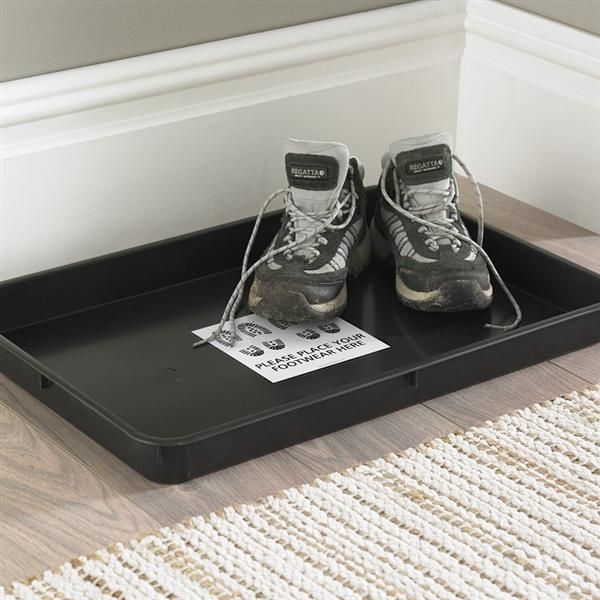
Here’s the heart of the whole system: shoes come off, shoes land on the tray, period.
No decisions, no walking down the hall.
Start with what you own. A flat baking sheet or a serving tray from the back of a cabinet does the job for $0. A dedicated low-profile shoe tray costs about $10 to $20 at Walmart or Target.
Size it to hold six to eight pairs of everyday shoes, which is realistically what a family cycles through in a week.
A tray outperforms a rack here because it has an edge. Shoes inside the lines look lined up; shoes outside the lines look obviously wrong, even to a seven-year-old in a hurry.
3. A Vertical Rack for a Tiny Entry
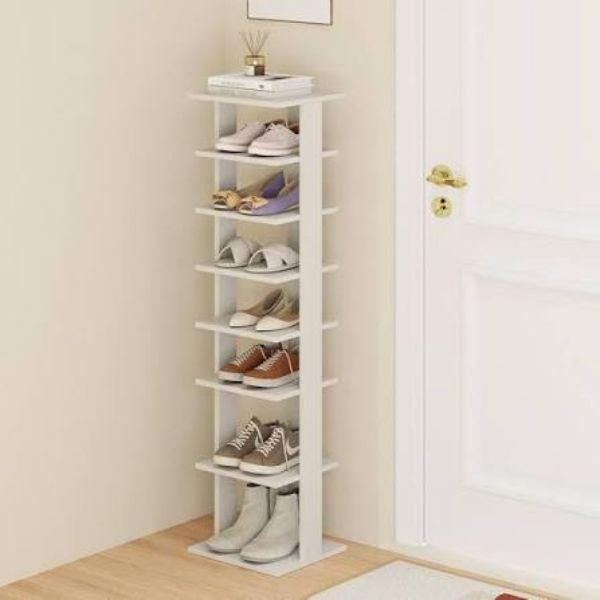
When your entry is three feet wide, and a bench is out of the question, the only space left is the wall. Expect $25 to $60 for an over-the-door or wall-mounted shoe rack at Walmart or Amazon, depending on how many tiers you get. Three tiers hold nine to twelve pairs, which clears the whole floor in most entryways.
Our first place had a front door that opened straight into a four-foot square of linoleum. There was no room for furniture, so a rack went on the wall beside the door, and that was the entryway.
Measure your door swing before mounting. In a tight entry, shoe organization has to climb the wall, and a rack that blocks the door gets abandoned by Thursday.
4. A Cubby Bench
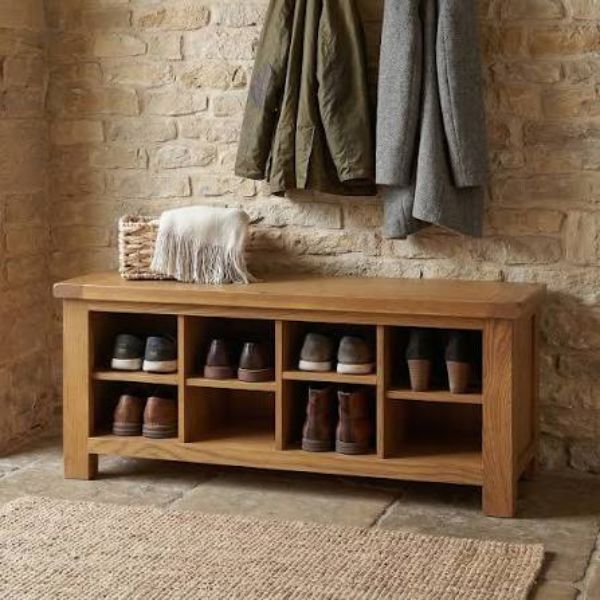
A cubby bench does two jobs: somewhere to sit while wrestling off boots, and a slot per person underneath. A store-bought one runs $80 to $200 at Target or Amazon, and the price mostly tracks how many cubbies you get. Four to six cubbies cover a typical family.
The $0 version is better than it sounds. Any bench, low shelf, or even a sturdy toy box you already own becomes a cubby bench once you line baskets underneath it, one per person.
Budget a real afternoon for assembly on a store-bought bench.
What makes a bench stick is the sitting. People take shoes off where they can sit down, so the storage ends up exactly where the shoes already come off. More on that in How to Get an Organized Entryway.
5. A Bin Per Kid
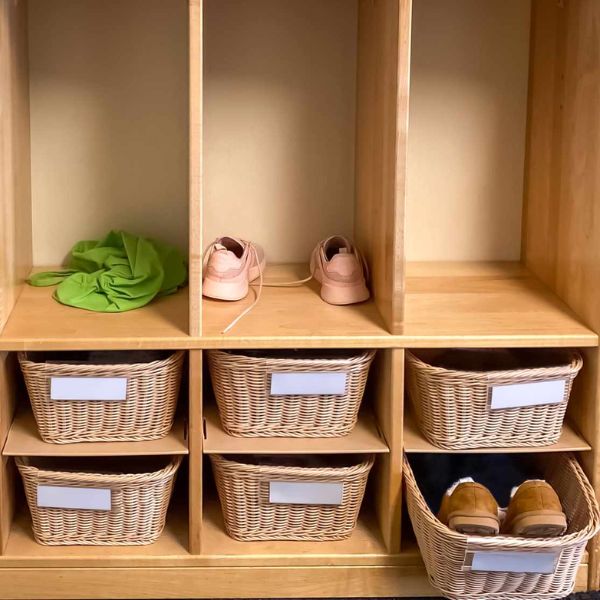
Kids will drop shoes into a bin with their name on it long before they’ll line them up on a rack. One bin per child, so three to five depending on your household. Dollar Tree carries basket-sized bins at $1.25, and sturdier open-top bins land around $5 to $10 each at Target.
Skip lids. A lid is one extra step and the step where kids quit.
Label with a name for readers and a color for the ones who aren’t reading yet. Masking tape and a marker is fine; nobody’s grading it.
The ownership is what makes kids’ shoe organization survive. A shared pile belongs to nobody, but a bin with her name on it is hers, and so is the mess in it. More ideas in 26 Kids Organization Hacks That Survive Past the First Week.
6. A Slipper Basket
Winter means a third category at the door: the shoes you put ON when you come in. Slippers wandering around the house are why people walk through the entry in wet socks. A basket you already own works for $0, and a decent woven or fabric basket runs about $10 to $20 at Target or Walmart.
One basket serves the whole family if it’s big enough. Fourteen inches wide holds four to six pairs without stuffing.
Set it right beside the shoe tray so the swap happens in one spot: boots off, slippers on, done.
Nobody has to be reminded to put on something warm, and the slippers end up back in the basket on the way out the door.
7. A Pairs-at-the-Door Limit
Every door system fails for the same reason, and it isn’t the system.
It’s volume. No tray, rack, or bench handles eleven pairs per person.
Cost: $0. Set a number, usually two pairs per person at the door in summer and three in winter when boots are in play, and everything else goes to a bedroom or hall closet. Count what’s by the door right now and you’ll see the problem in about ninety seconds.
Do the count again at the start of each season, when the overflow creeps back in.
This is the item that makes every other one on this list work, because storage only looks like clutter when there’s more in it than it was built to hold.
In the Closet
8. A Closet Floor Rack
Closet floors collect shoes in a heap because nothing down there tells a pair where to go. A two-tier metal or plastic rack fixes that by giving every pair a slot you can see from the doorway. Before you buy, check whether a short shelf or an old bookcase shelf already in the house fits under your hanging clothes, since that costs $0 and does the same job.
Walmart and Amazon both list freestanding two-tier racks around $20 to $40. One rack holds six to nine adult pairs, so most adult closets need one and a shared closet needs two.
This closet shoe organization setup holds up because putting a shoe back takes the same effort as dropping it, which is the only reason any system survives past week one.
9. An Over-the-Door Shoe Organizer
Twenty-four pockets of storage appear on a door that was doing absolutely nothing. Hang one on the inside of a closet door or a bedroom door, and flats, sneakers, and sandals come off the floor entirely.
Fabric pocket organizers come in around $12 to $20 at Walmart. The Container Store carries sturdier canvas and clear-pocket versions closer to $25 to $35. One organizer handles about twelve pairs, which usually covers one adult or two kids.
Two things keep it working: hooks that sit flush so the door still closes, and loading the pockets only two-thirds full. Stuffed pockets sag and the organizer swings, and within a week everyone’s back to the floor.
10. Labeled Boxes for Dress Shoes
If you’ve ever dug through a closet floor at 7 a.m. looking for one black heel before a wedding, you already know why this matters. Years ago I finally sat down with a marker and labeled every dress shoe box in my closet, and I have never hunted for a pair since.
Start with the boxes the shoes came in, which cost $0. Dollar Tree sells plastic shoe boxes for $1.25 each, and clear stackable versions total about $8 to $12 at Target or The Container Store.
Box only the occasional pairs: dress shoes, heels, boots you wear twice a year. Four to eight boxes cover most closets. Everyday shoes stay out on the rack, or you’ll stop using the boxes by Thursday.
(More ideas like this in 18 Dollar Tree Closet Fixes That Work Better Than Container Store.)
11. Small-Closet Shoe Storage
Shallow closets don’t need more floor bins. They need height. Stackable shoe shelves and slanted racks use the empty air between the floor and your hanging hems, which in most closets is a solid two feet of wasted space.
Stackable units run close to $15 to $30 at Walmart or Amazon, and most come in sets that hold two pairs per tier. Two or three stacked gives you six pairs in the footprint of one.
Before buying, measure the depth of the closet. Anything under 14 inches deep needs the slanted style, where shoes angle toward you instead of sitting straight back.
For shoe organization small space fixes, go vertical. Another bin on the floor just becomes a second pile with walls.
12. Hanging Fabric Shoe Shelves on the Rod
Hanging fabric shelves slide onto the closet rod and give you five to ten cubbies without touching the floor. If a hamper or a storage tote already owns your closet floor, this is the easiest thing you can do.
Target prices canvas hanging organizers at $12 to $25, depending on the number of shelves. One takes about a foot of rod space. One per closet is plenty.
Hang it at the end of the rod nearest the door, because tucked behind the coats it gets ignored, and you’ve spent $20 on a fabric bag full of shoes you can’t see.
13. Tension Rods for Heels
A tension rod turns the dead space on a wide closet shelf into a heel shelf. Mount one rod a few inches above the shelf surface, then hook the heel of each shoe over the rod so the toe hangs down. Pairs stay upright, visible, and off the floor completely.
Tension rods cost about $1.50 to $5 at Dollar Tree, and sturdier spring-loaded versions run $8 to $12 at Walmart or Target. One 24-inch rod holds about six to eight pairs of heels.
This only works for shoes with a defined heel, so flats and sneakers stay on the rack below. The rod keeps working because hanging a heel is faster than lining it up straight.
14. Tall Boots Standing Upright
Tall boots flop over, crease at the ankle, and then slide under everything else in the closet. Rolled-up magazines or a pool noodle cut to the boot shaft height keeps them standing, and both cost $0 if you’ve got them in the house already. Pool noodles run about $1.25 at Dollar Tree in summer, and one noodle cuts into enough inserts for three or four pairs.
Store-bought boot shapers run $10 to $15 a pair at Amazon or Target, so the noodle version saves real money across four pairs.
Back when my kids were little, I kept a stack of cut noodles in a bag on the closet shelf and refilled boots the night they came off. Upright boots take half the closet space of collapsed ones.
15. A Shelf Riser for the Closet Top Shelf
Your closet’s top shelf usually wastes six to ten inches of air above whatever’s sitting on it. A shelf riser doubles that space, and the second level is the perfect height for shoes you wear a few times a month.
Plastic or wire shelf risers run $10 to $20 each at Walmart or Target. A standard closet shelf fits two side by side, so expect $20 to $35 for the pair.
Keep the heavier boots on the shelf itself and the lighter pairs up top, where you’d otherwise be reaching blind. Nothing stacked on a riser gets buried, which is exactly why shoes stay there instead of migrating back to the floor by the door.
In the Bedroom
16. Bed Risers to Make the Space Usable
If your bed sits too low for a bin to slide under, raise the bed. Risers add three to five inches of clearance, which is the difference between a bin that fits and a bin that wedges.
A set of four or eight will run you about $15 to $25 at Walmart or Amazon. Check the weight rating on the package before you buy, especially under a heavier mattress and box spring.
You do this once. Nobody has to lift a mattress corner to get the bin out, which is usually the reason under-bed storage quietly stops being used around day five.
17. A Rolling Under-Bed Cart for Daily Pairs
Wheels change how often a bin actually gets used. A rolling under-bed shoe cart with a low fabric or plastic frame totals about $25 to $40 on Amazon, and most hold eight to twelve pairs laid flat in two rows.
Before you buy, check whether it has wheels or plastic gliders. Gliders stick on carpet. Wheels roll out with a nudge from your foot, which matters when you’re holding coffee.
Fill it with the pairs in current rotation. Dress shoes you wear twice a year belong in a lidded box.
It takes one toe to open and one toe to close, which is why it still gets used in week three.
18. Low Bins in the Kids’ Closet
When a child can’t reach the spot where shoes belong, the shoes don’t go there. That’s most of what goes wrong with kids’ shoe organization, and the fix is height.
Put an open bin on the closet floor or on a shelf no higher than their shoulder. Dollar Tree bins run $1.25 each, and Target’s small open storage bins are around $5 to $10. Plan on one bin per kid per category: everyday sneakers, dressy pairs, outdoor shoes.
Leave them open. Shoes land in an open bin from three feet away, which is about the only form of putting away a six-year-old does without being asked twice. (More of this in 26 Kids Organization Hacks That Survive Past the First Week.)
19. Picture Labels Instead of Written Ones
My granddaughter can’t read yet, but she can match a photo. That’s really all toddler shoe organization takes. I snapped a picture of her sneakers, taped it to the front of her bin, and now she finds her own shoes during visits without anyone narrating it.
This costs $0. Use your phone photos printed at home, or just draw the shoe on masking tape with a marker. A label maker is around $20 at Target and completely unnecessary here.
Cover each label with a strip of clear packing tape. Paper labels on a closet-floor bin get kicked, scuffed, and peeled within a week, and a peeled label means the bin goes back to being anonymous.
20. A Basket at the Foot of the Bed for Tomorrow’s Pair
Shoes pile up at the front door partly because that’s where mornings start. Give the pair they need next a spot in the bedroom instead.
A small laundry basket or a plastic dishpan you already have costs $0. A woven bin that looks intentional at the foot of the bed costs around $12 to $20 at Target. One per bedroom, and one pair in it at a time.
The rule is what makes it stick: when tomorrow’s pair goes in, today’s pair comes out and goes back to its real home in the closet or the under-bed bin.
For Off-Season Shoes
21. Off-Season Bins
Half the shoes crowding your entry aren’t even in season. Snow boots in July and sandals in January sit in the spots your everyday pairs need. I found a pair of sandals in the entry closet one January and could not have told you how long they’d been sitting there.
Clear stackable bins cost around $8 to $15 each at Walmart or Target depending on size, and most households need two to four: one per person in a big family, or one shared bin per season in a smaller one. Garage shoe organization is the same move with more room, since a garage shelf holds the full set of bins and keeps them out of the entry closet entirely.
Clear sides matter more than a label, because you can see what’s inside without pulling the lid off. Swap bins the first weekend the weather really turns, the same way you’d switch over a closet.
The off-season bin holds up because the calendar does the reminding.
Your Entryway Can Finally Keep Up
That shoe pile by the door didn’t happen overnight, and it won’t disappear overnight either. But you don’t need more bins piled on top of bins. You need the right landing spot for the pairs that actually show up there every day.
Pick one, set it up this weekend, and let it earn its keep before you add another.