FTC Disclaimer: We do make money from this blog and may receive compensation for this work in the form of commissions, fees, and complimentary product access. Review our full FTC disclosure here.
A medical bill has a way of showing up at exactly the wrong time. You have already dealt with the appointment, procedure, or hospital stay, and now there is a number on a statement that may be more than you expected or more than you can realistically pay.
The first thing I would not do is panic and immediately put the whole thing on a credit card. A medical bill is not always the final number, and there are several things worth checking before you decide how to pay it. The goal here is pretty simple: Make sure the bill is right, find out whether you qualify for any help, and then negotiate what is left.
Start by Asking for an Itemized Bill

If all you have is a statement showing a balance due, ask the provider for an itemized bill before you start negotiating. You want to see each individual service, procedure, medication, supply, or facility charge that makes up the total. The Consumer Financial Protection Bureau (CFPB) specifically recommends checking whether the charges are accurate, whether they match the services you actually received, and whether anything appears to have been billed twice.
If you used insurance, pull out your Explanation of Benefits (EOB), too. The EOB is not a bill; it’s the insurer’s explanation of what was billed, what it allowed, what it paid, and what it says you may owe. I would compare the EOB against the provider’s statement before making any payments.
You are looking for a few, fairly basic, things:
- A service you do not remember receiving
- The same service appearing twice
- Insurance payments or adjustments that do not appear on the provider bill
- An out-of-network charge you were not expecting
- A balance that simply does not match the amount your insurer says is your responsibility
You do not need to understand every medical billing code before you call. If something does not make sense, ask the billing office to explain it. I would much rather spend 20 minutes doing these basic tasks than begin negotiating a balance that was wrong to begin with.
Check Whether the Bill Is Protected by Federal Billing Rules
Before you treat the balance as something you just need to haggle down, check whether some of it may be protected under the No Surprises Act. For people using most types of private insurance, federal protections generally apply to certain unexpected out-of-network charges from emergency care, some non-emergency care at in-network facilities, and air ambulance services.
If you did not have insurance or chose not to use it, there is a different protection worth knowing about. Providers generally must give you a good-faith estimate for scheduled care, and you may be able to use the federal patient-provider dispute process when a bill from a provider or facility is at least $400 higher than its estimate, provided other eligibility requirements are met. It is not really a negotiation tactic but a billing-rights issue.
So, if your bill looks wrong because of an unexpected out-of-network charge or because it came in quite higher than a good-faith estimate, I would check your rights before jumping straight to, “Will you take less?”
Ask About Financial Assistance Before Asking for a Discount

This is one of the easiest steps to miss. Call the billing office and ask, “Do you have a financial-assistance or charity-care program, and can you send me the eligibility requirements and application?”
Nonprofit hospitals are required to maintain written financial-assistance policies that explain who qualifies, what assistance is available, and how to apply. Do not assume you make too much money to qualify—eligibility rules vary by hospital, and financial assistance is not necessarily limited to people with no income. The CFPB notes that these programs can help uninsured patients as well as people who have insurance but are still struggling with what they owe.
Some for-profit and private hospitals also offer assistance, even when they are not subject to the same nonprofit-hospital requirements. The application may ask for things like income information, tax forms or pay stubs, and household expenses. Yes, that is a bit more paperwork than simply asking for 10% off, but the potential reduction can be much more meaningful.
Cash-Pay Pricing and Negotiating an Existing Balance Are Not the Same Thing
People sometimes lump these concepts together, but I would treat them as two separate conversations. Here’s why.
A cash-pay or self-pay rate is generally the price a provider offers when care is being paid without insurance.
A settlement, reached through a negotiation, is an agreement to accept less than the existing balance, often in exchange for paying the agreed-upon amount at once.
If you are looking at a bill after insurance has already processed the claim, I would not just call and ask, “What is your cash price?” I would be more specific: “If I can pay this balance in one payment, is there a discount or settlement amount available?”
Centers for Medicare & Medicaid Services (CMS) specifically advises patients who cannot afford a bill to ask the provider whether the bill can be reduced and notes that hospitals and medical offices will in fact, lower the price sometimes. If you are uninsured or truly self-paying, then it also makes sense to ask about the provider’s self-pay rate and compare it with the amount you were billed.
Hospitals are required to publish certain standard-charge information, so pricing information can also give you some context before you call. CMS recommends researching hospital pricing and asking about comparable charges in your area.
You do not need to walk into the conversation pretending you are a professional medical-bill negotiator. You are just trying to understand whether the balance in front of you is the only amount the provider will accept.
If You Can Pay a Lump Sum, Ask What That Changes
The strongest simple negotiation tool you may have is the ability to pay an agreed-upon amount immediately. Try something like: “I can’t manage the full balance, but I may be able to make a one-time payment. Is there a reduced amount you could accept as payment in full?” Then stop talking and let them answer. If they offer a discount that is still too high, it is reasonable to ask whether there is any additional reduction available.
I would also get the agreement in writing before making the payment, particularly if the provider is agreeing to accept less than the amount originally billed. You want the documentation to make clear what you are paying and how the remaining balance will be handled.
Do not promise a lump sum you cannot actually afford just because the person on the phone offers you a deadline. A discount is not much of a win if paying it wipes out the money you need for rent, groceries, utilities, or another unavoidable bill next week.

If a Lump Sum Is Not Realistic, Ask for an Interest-Free Payment Plan
Sometimes the bill is accurate, and you simply do not have enough cash to pay it all at once. Ask the provider directly whether they offer an interest-free payment plan and what the lowest monthly payment can be.
The CFPB specifically lists interest-free repayment plans as an option when a medical balance remains after you have reviewed and negotiated it. This is one place where I would be careful about confusing a hospital payment plan with medical financing. A provider may offer an internal payment arrangement with no interest. A medical credit card or third-party financing product can be something very different.
Further, the CFPB warns that some medical credit products use deferred-interest promotions, where high interest may become due if the balance is not paid within the promotional period or other terms are not met. It also cautions that putting the bill on a regular or medical credit card can make financial-assistance options more complicated.
So, before you move a medical bill onto any credit product, ask if the provider can simply divide the balance into manageable monthly payments. I would much rather have a $150 monthly payment at 0% than turn a negotiable medical bill into high-interest revolving debt.
Keep Notes Every Time You Call
This is painfully boring advice, which is usually how you know it is useful.
Whenever you call someone about your bill, write down:
- The date and time
- The phone number you called
- The name of the person you spoke with
- What they offered
- What you agreed on
- When you are supposed to hear back
- Any reference or case number(s)
CMS also recommends keeping track of who you spoke with and any reference numbers because you may need to contact the billing office again. Medical billing conversations have a habit of stretching across multiple calls. You do not want call number four to begin with you trying to remember what “Jennifer, maybe in billing?” told you three weeks ago on call number one.
What If You Do Not Want to Negotiate the Bill Yourself?
There is a point where doing all of this yourself begins to lead to diminished returns. If the bill is relatively small, straightforward, and you have the time to make a couple of phone calls, then yes, running this process alone makes sense. If the balance is large, the charges are confusing, you are disputing multiple things at once, or you simply do not have the bandwidth to spend your week calling billing departments, this is where a medical-bill advocacy service can be the right move.
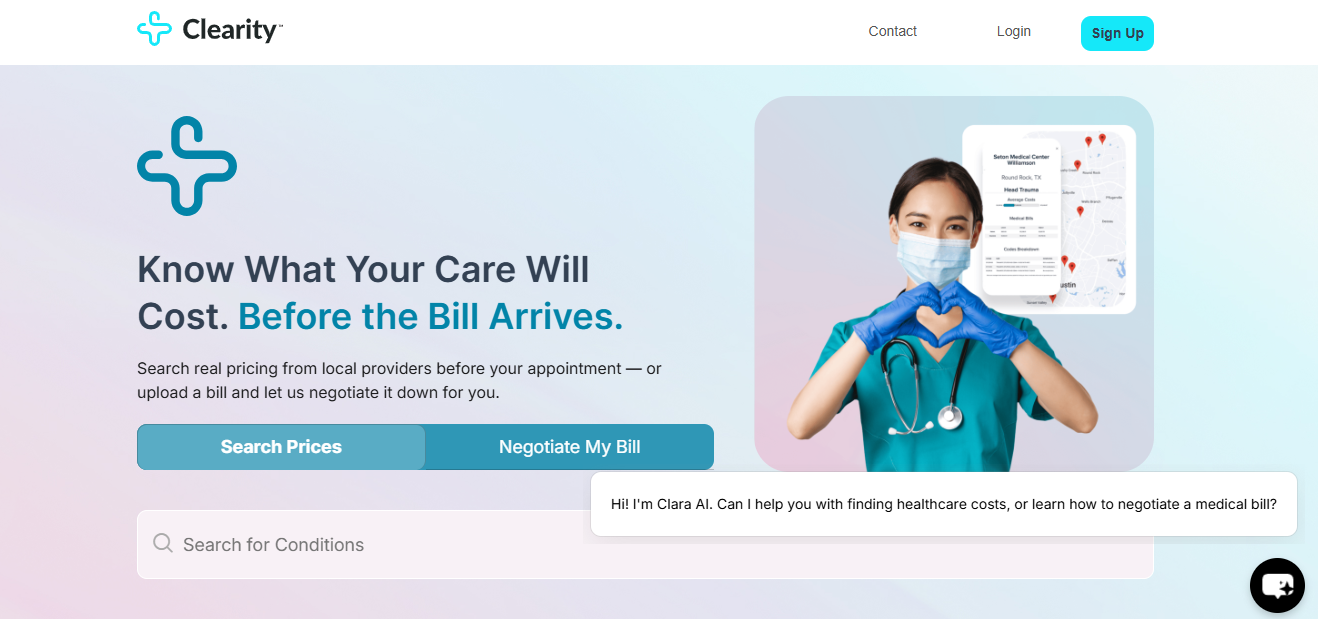
Clearity Health, for example, reviews bills line by line for things such as questionable charges, duplicate charges, overcharges, or services the patient may not have received. The team then explains the bill and can negotiate directly with the billing department on the patient’s behalf.
The pricing model is worth understanding before you bring in an advocate. Clearity does not charge an upfront fee: If the company saves you money, its fee is 20% of the amount saved, capped at $1,000. If there is no savings, there is no fee.
So, if Clearity Health negotiates a $10,000 bill down to $7,000, that is $3,000 in savings. The 20% contingency fee applies to that $3,000, not the original $10,000 bill, which would make the fee $600. You would still come out $2,400 ahead, compared with paying the original balance.
Whether that is worth it to you depends on the bill and how much you value handing off the negotiating work. I would not pay someone to make a two-minute call about a $200 balance, but once you are dealing with a much larger bill, multiple line items, repeated calls, or a situation you do not really understand, paying a percentage of actual savings can be a reasonable trade.
Clearity’s service is available for bill review and negotiation across the United States, and the company works only with the bills and information patients submit through its official intake process.
Do Not Let the First Bill Force You into a Bad Financial Decision

There is a difference between avoiding a bill and slowing down long enough to deal with it intelligently. Ignoring it is not a great plan, but neither is immediately draining your savings or putting thousands of dollars on a credit card before you even know if the amount is right.
My order would be:
- Get the itemized bill.
- Compare it with your EOB if insurance was involved.
- Question anything that looks incorrect.
- Check whether federal billing protections apply.
- Ask about financial assistance or charity care.
- Ask what discount is available for a lump-sum payment.
- If that does not work, ask for an interest-free payment plan.
- If the bill is too complicated or the negotiation becomes more than you want to handle, consider bringing in an advocate.
That gives you several chances to improve the situation before you start borrowing money to solve it. And that is really the part I wish more people knew about medical bills. You can take the statement seriously without automatically assuming the first number printed on it is the number you have to write a check for.