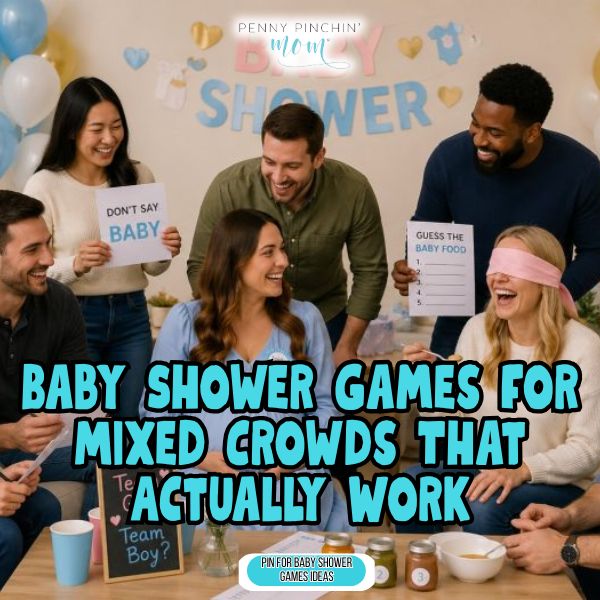
You’ve planned the menu, ordered the decorations, and triple-checked the guest list. Then reality hits: your shower includes your sister’s college friends who live for party games, your partner’s reserved coworkers who’d rather hide in the kitchen, your elderly aunt who can’t stand for long, and that cousin who rolls her eyes at anything that sounds “corny.” Choosing baby shower games that work for this mixed group feels impossible, and forcing participation will make everyone miserable.
The good news? You don’t need every guest playing every game to create interactive baby shower games that actually work. What you need is a strategy for reading your specific crowd and choosing formats that let people participate at their comfort level. This means matching baby shower entertainment to your group’s energy level, physical abilities, and tolerance for attention, while giving reluctant guests an easy out that doesn’t make them feel like party poopers.
You’ll learn how to assess your guest mix before the shower (so you’re not guessing on game day), how to choose between active baby shower games and low-key options based on group dynamics, and how to structure participation so nobody feels cornered into playing. Whether you’re hosting baby shower games for large groups that include strangers or baby shower games for small groups where everyone knows each other’s boundaries, the goal is the same: creating moments of connection without the cringe factor.
Sort Your Guest List Into Three Participation Categories
The biggest mistake hosts make is choosing games they personally love without considering who’s actually showing up. Your guest list tells you everything you need to know about which group baby shower games will land and which will flop.
Start by sorting guests into three categories:
Enthusiastic players: People who arrive ready to participate, volunteer first, and genuinely enjoy organized activities. This usually includes close friends of the parents-to-be, young relatives, and anyone who’s recently hosted their own shower.
Polite participants: Guests who’ll join if asked directly but won’t volunteer. They’re fine playing as long as it doesn’t require performing or getting too silly. Think coworkers, distant relatives, or introverted friends who came to celebrate but not to be the center of attention.
Active avoiders: People who will physically leave the room, claim they need to check on food, or suddenly find their phone fascinating when games start. Often includes dads, male relatives at co-ed showers, older guests with mobility issues, or anyone who’s openly expressed game fatigue.
Once you’ve mentally sorted your list, count the ratio. If you have 8 enthusiasts, 12 polite participants, and 5 avoiders in a 25-person shower, you’re working with a moderately game-friendly crowd. If those numbers flip and you’ve got 15 avoiders, you need a completely different approach.
If you’re unsure, ask the parents-to-be what their guests are like. They know whether their friend group bonds over competition or prefers background activities while catching up.
Factor In Physical Space, Age Range, and Event Timing
Your guest mix is only half the equation. These practical factors determine which interactive baby shower games will actually work in your specific situation:
- Group familiarity: Strangers won’t participate at the same level as tight friend groups. Baby shower games for large groups with mixed crowds need simpler rules and lower stakes.
- Physical space: A packed living room limits your options for active baby shower games that require movement.
- Age range: Guests in their 70s and guests in their 20s have different physical capabilities and patience levels for standing games.
- Event timing: Evening showers after work get less energetic participation than Saturday afternoon gatherings.
- Shower type: Work showers need different team-based baby shower games than family-only celebrations.
Match Game Format to Participation Style (Not Guest Count)
Group size matters less than participation style when choosing interactive baby shower games. A room of 15 game-lovers will handle complex team-based baby shower games better than 30 people who’d rather not play at all.
For crowds with mostly enthusiastic players and polite participants:
Active baby shower games work here because enough people will voluntarily engage. Choose formats with clear start and end times (nobody wants a game that drags). The Don’t Say Baby necklace game runs in the background the whole shower long, letting people participate passively while mingling. Baby bingo cards work during gift opening, giving guests something to do without requiring them to perform. Guess-the-baby-photo contests let people study a board at their own pace rather than being put on the spot.
Group baby shower games that split people into teams work when you have 20+ guests, and most will play. Teams diffuse individual pressure since shy guests can let louder teammates take the lead. Keep teams to 4-5 people maximum so everyone gets involved, but nobody feels singled out. Diaper-decorating contests, baby-item price-guessing competitions, or timed baby-food taste tests all work with this format.
For crowds with significant avoiders (30% or more of your guest list):
Drop games that require everyone’s participation and choose formats where playing is obviously optional. Set up activity stations guests can visit when they want: a onesie decorating table with fabric markers, a wishes-for-baby card station, or a guess-the-baby-item-weight display. These baby shower games for small groups or large groups create participation opportunities without forcing anyone into a circle.
Skip icebreaker-style games where you go around the room sharing. Every avoider in the room is mentally calculating when their turn comes up and planning their escape. Replace with games people can drop in and out of, like a running belly-measurement-guess station or a “predict the birth date and weight” chart on the wall.
For mixed crowds where you can’t predict participation:
Have two types of entertainment ready. Plan one short, inclusive game for the willing participants (10-15 minutes maximum) and one passive activity that doesn’t require buying in. For example, run baby bingo during gift opening while also having a photo booth area set up. People who want structure get it; people who want to avoid it have somewhere else to be, that’s not obviously hiding.
The key is making non-participation look like a valid choice, not an awkward opt-out. When you say, “We’re going to play baby bingo during presents: cards are on your seats if you want to join,” you’ve just given permission to skip it. When you say, “Everyone grab a bingo card, we’re playing during gifts,” you’ve cornered people into either playing or looking rude.
Structure Participation So Nobody Feels Trapped
How you introduce and run games determines whether reluctant guests relax or start planning their exit strategy. The difference between successful interactive baby shower games and cringey disasters is often just your facilitation approach.
Set up opt-in language from the start. When you transition to games, say “For anyone who wants to play, we’ve got [game name]” instead of announcing “It’s game time, everyone.” This immediately signals that participation is a choice, not a requirement. Place game materials in a central location that guests can approach, rather than walking around handing items to everyone, which feels like being voluntold.
Eliminate performance pressure. Any game requiring individuals to stand up, speak in front of the group, or be watched by everyone will lose your avoiders immediately. Instead of “Let’s go around and everyone share their best parenting advice,” try a card system where guests write advice anonymously, and you read selections aloud. Nobody’s on the spot, but you still get the content.
Keep timing tight. The faster a game moves, the less awkward it feels. Baby shower games for large groups should wrap up in 15 minutes or less. For baby shower games for small groups, aim for 10 minutes. If you’re running multiple games, space them out with 30-45 minutes between. Back-to-back games feel like a game show instead of a celebration, and your avoiders will check out completely.
Offer simultaneous activities. When you start a team-based game, make sure the food table is still accessible, the bathroom isn’t blocked, and there’s a clear “not playing” zone people can occupy without looking antisocial. If your space is small, consider timing games for when some guests are naturally elsewhere: run baby bingo during gift opening when some people will be taking photos or helping with presents anyway.
Plan for the silent majority. Your enthusiastic players will drive participation, but your polite participators need gentle nudging. When forming teams, assign people to groups rather than asking for volunteers (which puts shy people in the position of either raising their hand or looking uncooperative). For guess-the-game activities, pass around a clipboard instead of asking people to shout out answers. Introverts will participate in writing when they’d never speak up.
Have a backup plan for flopped games. If you introduce a game and get visibly uncomfortable responses, acknowledge it and move on immediately. Say “Looks like we’re all gamed out: let’s just hang out and eat” rather than trying to force it. Your guests will remember you reading the room, not that the game didn’t happen. Keep 2-3 simple activities in your back pocket (like the wishes-for-baby cards or onesie decorating station) that require zero group coordination as backup options.
The right baby shower entertainment isn’t about finding games everyone will love. It’s about creating a mix where everyone can participate at their comfort level. Before the shower, honestly assess your guest list’s game tolerance and choose formats that match. Then structure the actual event so playing feels optional, not mandatory, by using clear opt-in language, keeping games short, and offering passive alternatives for avoiders.
Your next step takes 10 minutes: Write down your guest list and mark each person as enthusiastic, polite, or avoider. If avoiders outnumber enthusiasts, swap your planned group games for the drop-in activity stations described in section three. If enthusiasts dominate, keep your team games but cap them at 15 minutes each using the timing guidelines from section four. Match your game plan to your actual guests, not to Pinterest perfection, and half your stress disappears before the shower even starts.