If your child graduated without taking the SAT or ACT, or if you’re thinking about going back to school yourself and those tests feel like a distant memory, you’ll be happy to hear that most online colleges don’t require them at all. More than 1,800 colleges and universities in the United States have made the SAT and ACT optional or dropped them entirely, and among fully online programs, skipping the SAT and ACT has become close to standard practice.
Here’s what you need to know about how these schools work, what they look at instead, and how the costs actually compare.
Why So Many Online Programs Have Dropped the Test Requirement
Online colleges are largely built around adult learners and non-traditional students, such as someone returning to school after 10 years in the workforce, a parent who stopped after her kids were born, or a military veteran transitioning to civilian life. None of these applicants are well evaluated by a test they may have taken as a teenager. The SAT and ACT were designed to predict first-year college performance for recent high school graduates. For everyone else, they’re mostly irrelevant.
The test requirement has also historically created a hidden cost. Prep courses, test fees, retakes, and score submission fees add up fast. Removing that requirement doesn’t just simplify the application; it also removes a financial hurdle that has nothing to do with whether someone can succeed in college.
What Schools Look at Instead
Dropping the test requirement doesn’t mean dropping standards. What schools review instead depends on the admissions model:
- Test-optional schools still evaluate your overall application: GPA, coursework, essays, and sometimes letters of recommendation. Not submitting a score won’t hurt you, but a stronger academic record still gives you an advantage.
- Open admission schools accept any applicant who holds a high school diploma or GED equivalent. There’s no GPA minimum, no essays, and no interview. The competitive part of the process happens after enrollment, through the coursework itself
Understanding which model a school uses tells you what you’re actually walking into. An open admissions program is not the same as a low standards program. Schools with open admissions often have rigorous coursework once you’re in; the door is just wider at the entrance.
Online Colleges That Don’t Require SAT or ACT Scores At a Glance
| School | Learning Model | Financial Aid | Accreditor | Cost for Bachelor’s Degree | Best For |
|---|---|---|---|---|---|
| Western Governors University | Competency-based | Yes | Northwest Commission on Colleges and Universities | ~$3,800 to $5,300 per six-month term (flat rate) | Students with prior work experience who can move fast |
| Southern New Hampshire University | Term-based | Yes | New England Commission of Higher Education | ~$354 per credit hour | Students wanting traditional structure with a recognized name |
| University of Maryland Global Campus | Term-based | Yes | Middle States Commission on Higher Education | ~$337 per credit hour in-state, $499 out of state | Adult and military-affiliated learners |
| University of the People | Term-based | No | Western Association of Schools and Colleges | $180 assessment fee per course (no tuition) | Cost-focused learners who need maximum flexibility |
| Northeastern University Online | Term-based | Yes | New England Commission of Higher Education | ~$560 per credit hour | Working adults in career-focused fields |
Breaking Down Each Option
Southern New Hampshire University
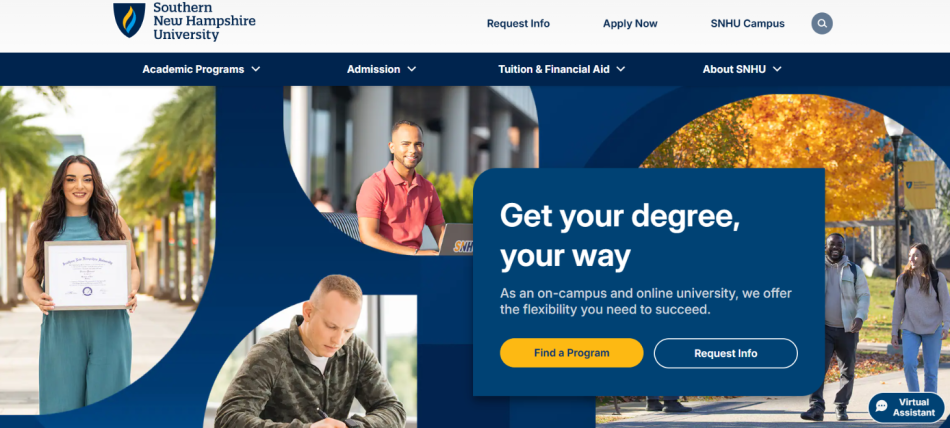
Southern New Hampshire University is one of the most recognized names in online education and one that employers have come to know over the past decade. It’s test-optional, meaning you apply without submitting scores, but your GPA and coursework history still factor into the decision. Tuition runs about $354 per credit hour for online undergraduate programs. A full bachelor’s degree typically requires 120 credits, putting total tuition around $42,500 before any financial aid or scholarships. SNHU participates in federal financial aid, so Pell Grants and student loans apply.
Western Governors University
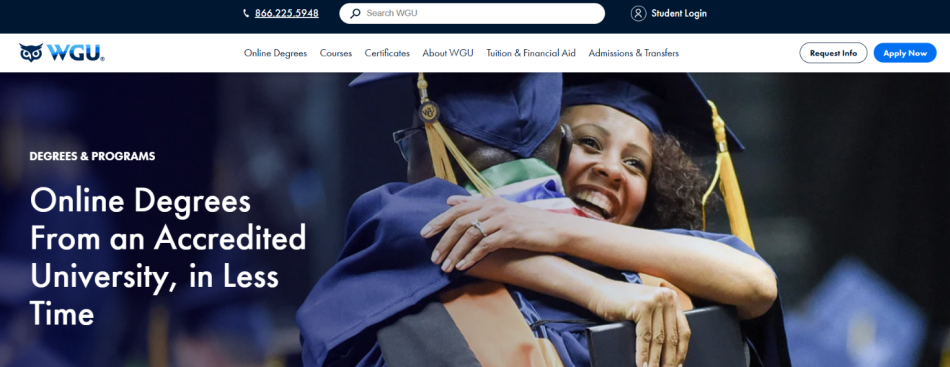
Western Governors University uses an open-admissions model paired with a competency-based curriculum, meaning you advance by demonstrating you’ve mastered the material rather than by sitting through a set number of weeks. That’s a meaningful advantage for students who already have relevant work experience or prior knowledge, since you can move faster through content you already know. Tuition is a flat rate per six-month term, currently roughly $3,800 to $5,300 depending on your program, plus a $200 per-term resource fee. You can take as many courses as you can manage in that window. For a fast mover, the total cost of a degree can be significantly lower than the per-credit-hour rate at other schools, and they participate in federal financial aid.
University of Maryland Global Campus
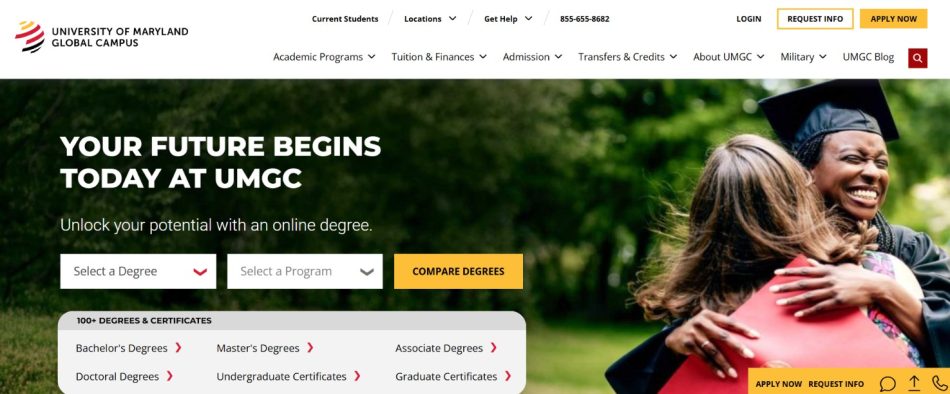
University of Maryland Global Campus is a public institution built specifically for adult learners and military-affiliated students. Open admissions at the undergraduate level means no test scores and no GPA minimum, just a high school diploma and official transcripts from any prior college experience. Undergraduate tuition runs $337 per credit hour for Maryland residents and $499 for out-of-state students, and federal financial aid is available. Military students and eligible family members pay a reduced rate of $250 per credit hour.
Excelsior University
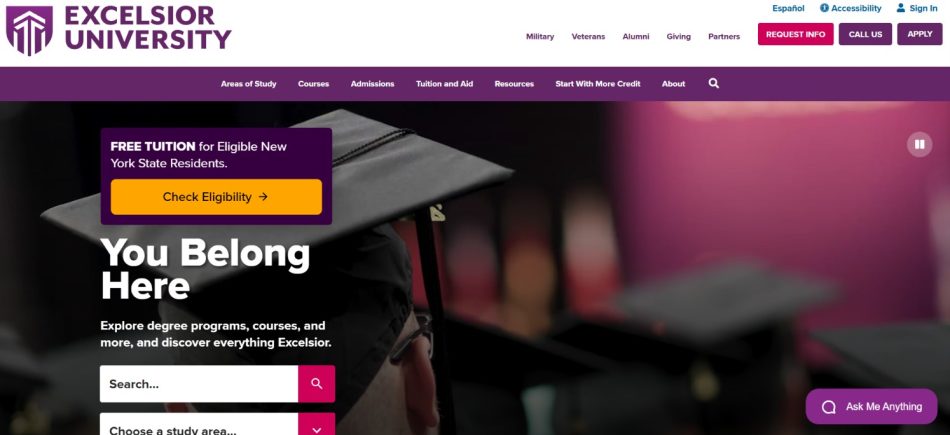
Excelsior University is worth knowing about if you or your student have significant credits from prior coursework, military training, or professional certifications. Excelsior’s model is specifically designed around transfer credit: students often arrive with large amounts of existing credit from community college, prior degrees, military training, and formal professional programs, and Excelsior helps them apply that credit toward a degree. They offer open admissions with no test scores. At around $510 per credit hour for non-nursing programs, it’s not the cheapest option listed here, but for someone who arrives with 60 or 80 transferable credits, the total cost of completing a degree compresses dramatically. Excelsior participates in federal financial aid.
University of the People
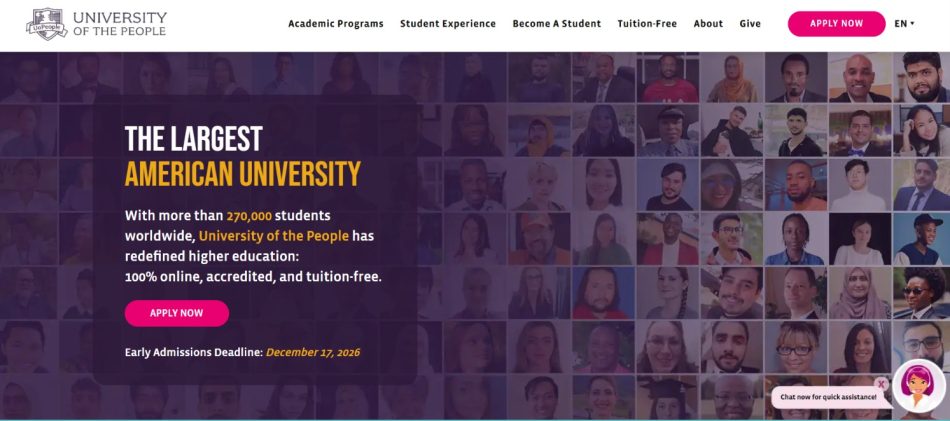
University of the People is a nonprofit, tuition-free online university, so students pay only a $180 assessment fee per undergraduate course. That works out to about $7,260 for a bachelor’s in business administration or computer science and about $7,080 for health science, plus a $60 one-time application fee. Admissions are fully open, with no SAT, no ACT, and no GPA minimum. The school is accredited by the WASC Senior College and University Commission. The tradeoff is that it does not participate in federal financial aid, so Pell Grants and federal student loans don’t apply, though scholarships are available and the school waives fees for students who cannot afford them.
The Real Cost Question to Ask
When comparing these schools, the per-credit-hour number is only part of the picture. A few things worth calculating before you decide:
- How many credits does the degree require? Programs vary between 120 and 135 credits for a bachelor’s degree. A school with a lower per-credit rate but more required credits can end up costing more than a school with a higher per-credit rate with fewer credits.
- What federal aid would you actually receive? If your family qualifies for a significant Pell Grant, that changes the net cost of the schools that participate in Title IV. A school that seems more expensive before aid may be comparable or cheaper after it.
- How much prior credit do you or your student have? Schools like Excelsior and Western Governors University are built around recognizing prior learning. If you have community college credits, AP credits, military training, or professional certifications, those can significantly reduce the number of courses you need to pay for.
- What’s the total cost at the pace you can realistically manage? University of the People’s per-course fee model benefits part-time students taking one or two courses at a time. Flat-rate schools like Western Governors University benefit students who can move quickly.
Accreditation: The One Thing to Always Check
The one non-negotiable to verify before enrolling anywhere is regional accreditation from one of the seven bodies recognized by the Department of Education. That accreditation is what determines whether an employer will recognize your degree, whether your credits can transfer to another institution, and whether you can access federal financial aid.
All of the schools in this piece hold regional accreditation. If you’re evaluating any school not on this list, verify its accreditation in the Department of Education’s database before going any further.
The absence of a test score requirement opens the door. What matters next is finding the school whose cost structure, accreditation, and degree programs actually fit your family situation and budget.