For families trying to keep college costs from spiraling, the nonprofit distinction matters more than most people realize. Nonprofit universities reinvest tuition revenue into programs and student services rather than returning profits to shareholders. That difference in structure tends to mean lower tuition, less aggressive marketing, and an institutional incentive that’s at least pointed in the direction of student outcomes rather than enrollment numbers.
The online nonprofit landscape has expanded significantly in the last decade. There are now legitimate, accredited options across a wide range of price points and learning models, and the right fit depends less on which school has the best ranking and more on how you actually learn and what your life looks like while you’re earning the degree.
This piece covers the strongest options across two learning models and what each one means for the kind of student it best serves.
Why the Learning Model Matters as Much as the School Name
Most best-of lists for online universities are sorted by price or prestige. A more useful filter for working adults is the learning model, because it determines whether the program will actually work around your life.
Competency-based programs let you move at your own pace by demonstrating mastery of material through assessments rather than completing a fixed number of course weeks. If you already know the subject matter from work experience, you can move through it quickly.
Term-based programs follow structured academic calendars with weekly deadlines and set start dates. You’re not waiting around to show mastery; you complete assigned work within each week’s window and advance with your cohort. This model tends to suit students who want clear structure and regular checkpoints.
Nonprofit Online Universities At a Glance
| School | Learning Model | Financial Aid | Accreditor | Cost for Bachelor’s Degree | Best For |
|---|---|---|---|---|---|
| Western Governors University | Competency-based | Yes | Northwest Commission on Colleges and Universities | ~$3,800 to $5,300 per six-month term (flat rate) | Students with prior work experience who can move fast |
| Southern New Hampshire University | Term-based | Yes | New England Commission of Higher Education | ~$354 per credit hour | Students wanting traditional structure with a recognized name |
| University of Maryland Global Campus | Term-based | Yes | Middle States Commission on Higher Education | ~$337 per credit hour in-state, $499 out of state | Adult and military-affiliated learners |
| University of the People | Term-based | No | Western Association of Schools and Colleges | $180 assessment fee per course (no tuition) | Cost-focused learners who need maximum flexibility |
| Northeastern University Online | Term-based | Yes | New England Commission of Higher Education | ~$560 per credit hour | Working adults in career-focused fields |
Competency-Based: Move at Your Own Pace
Western Governors University
Western Governors University is the best-known competency-based nonprofit in the country, and its model rewards students who arrive with relevant knowledge. Rather than paying per credit or sitting through weeks of material you already know, you pay a flat rate of roughly $3,800 to $5,300 per six-month term, depending on the program, plus a $200 per-term resource fee, and complete as many courses as you can within that window. If you’ve spent years working in IT and enroll in a computer science program, you may move through foundational courses in days rather than weeks.
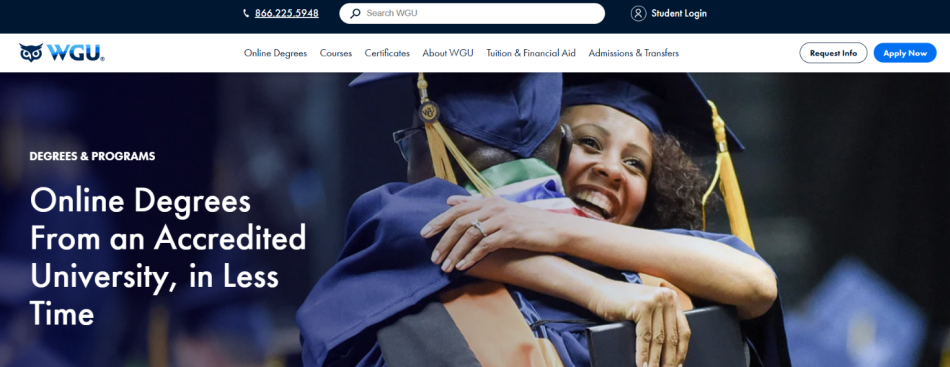
WGU is regionally accredited through the Northwest Commission on Colleges and Universities, the same type of institutional accreditation held by major state universities, with additional accreditation for its business, nursing, and education programs.
The tradeoff: WGU’s official transcripts use pass or not-pass marks and don’t calculate a GPA, so graduate programs with a minimum GPA may weigh test scores or work experience instead. If graduate school is a long-term goal, check your target programs before you enroll.
Term-Based: Structure with Flexibility
Southern New Hampshire University
Southern New Hampshire University is one of the most widely recognized names in online education. Roughly 184,000 students were enrolled exclusively online in 2024-25, according to federal data compiled by CollegeEvaluator. The catalog covers business, healthcare, education, technology, and more. It’s accredited by the New England Commission of Higher Education, runs on eight-week course terms, and charges $354 per credit hour for online undergraduate programs. The name has become familiar to employers in a way that some newer online schools haven’t yet achieved.
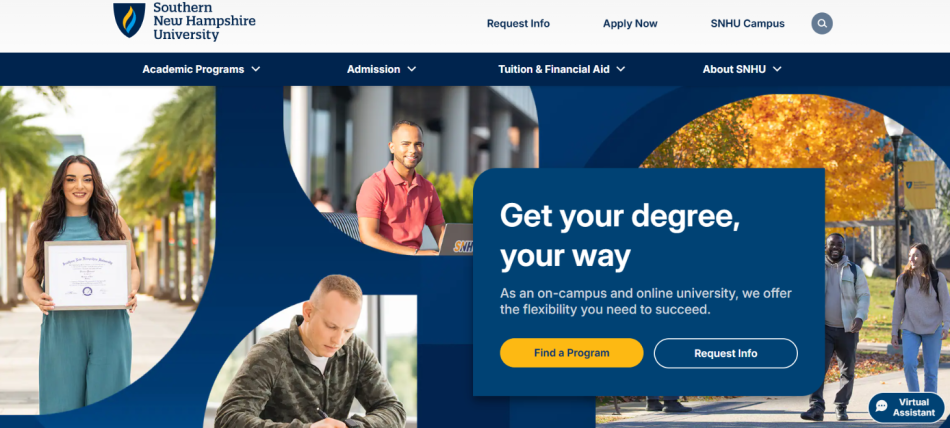
The tradeoff: at 120 credits, SNHU puts total tuition for a bachelor’s degree at around $42,480 before aid, which is significant. For students who qualify for Pell Grants or institutional scholarships, the net price drops, but the sticker price is worth knowing going in.
University of Maryland Global Campus
University of Maryland Global Campus is a public nonprofit built specifically for adult learners and military-affiliated students. Accredited by the Middle States Commission on Higher Education, UMGC offers more than 100 degrees and certificates, including a wide range of online bachelor’s programs. Undergraduate tuition is $337 per credit hour for Maryland residents and $499 for out-of-state students, with a reduced military rate of $250 per credit hour. Federal financial aid applies. For veterans, active-duty service members, and government employees in the mid-Atlantic and surrounding region, UMGC consistently comes up as one of the most practical options because of its cost, its familiarity to employers in that area, and its experience serving that population.
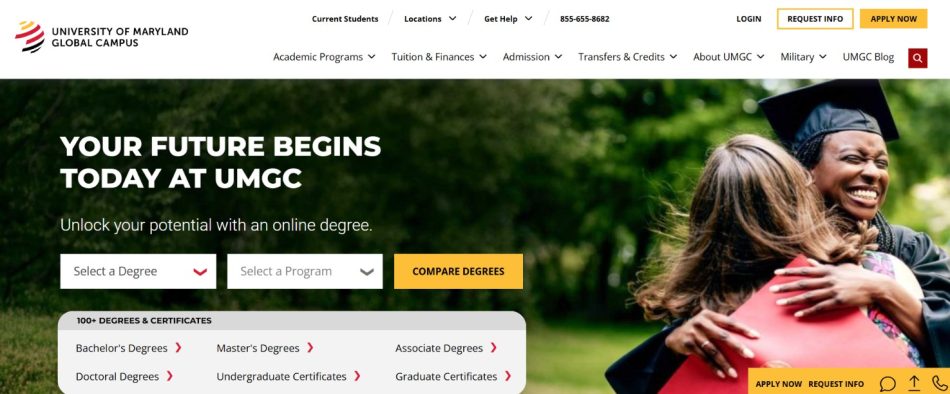
The tradeoff: the lower rate applies only to Maryland residents, so out-of-state students pay about 50 percent more per credit. UMGC’s catalog is also concentrated in fields like business, IT, cybersecurity, and public safety rather than the full range a large research university offers.
University of the People
University of the People charges no tuition. Students pay a $180 assessment fee per undergraduate course, which works out to about $7,260 for a business administration or computer science bachelor’s, $7,080 for health science, and about $4,000 for general studies, plus a $60 one-time application fee. The school is accredited by the WASC Senior College and University Commission, delivery is fully asynchronous with weekly deadlines and required discussion participation, and there’s no residency requirement. Scholarships are available through its foundation and corporate partners.
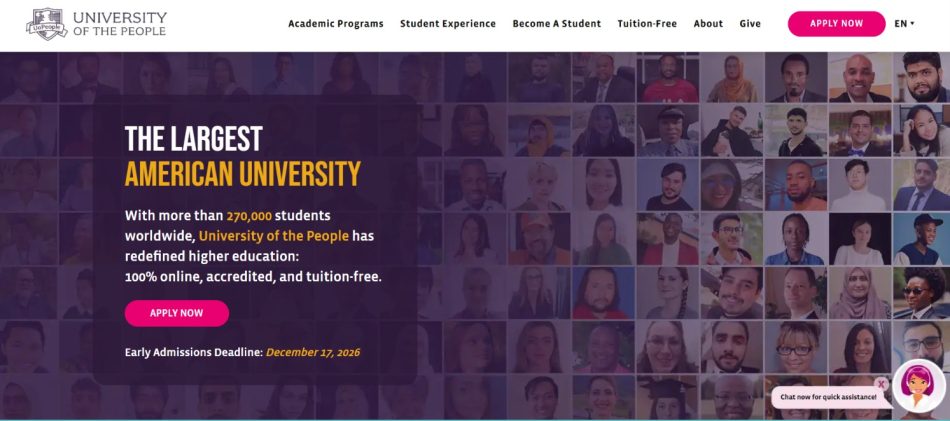
The tradeoff: University of the People does not participate in federal financial aid, so Pell Grants and federal loans don’t apply, and its undergraduate offerings are limited to business administration, computer science, health science, and general studies. It also has less name recognition than the larger schools on this list, which can matter in hiring contexts where the institution’s name carries weight.
Northeastern University Online
Northeastern University Online is the choice for working adults in career-intensive fields who want both a recognizable private nonprofit name and practical program design. The College of Professional Studies runs bachelor’s completion programs, which are built for students who already have college credit, at $560 per credit hour, with active-duty service members and their spouses eligible for a reduced rate of $259 per credit. Northeastern is accredited by the New England Commission of Higher Education and ranked among the top 50 national universities by US News. The school’s cooperative education model, which integrates professional work experience into degree programs, is a real differentiator for students looking to build employer relationships alongside their credentials. Federal financial aid is available through the FAFSA.

The tradeoff: bachelor’s completion means you need existing college credit to apply, and at $560 per credit hour, the final 60 credits alone come to about $33,600, well above most of the other options here.
How to Choose the Best Nonprofit Online University for You
For students with significant work in IT, business, or education who can study intensively: Western Governors University’s competency-based model will almost certainly produce the best combination of cost and speed.
For students who need name recognition for their target employers, want maximum program variety, or are planning to use federal financial aid: Southern New Hampshire University or University of Maryland Global Campus, depending on whether military affiliation or in-state status apply.
For students whose primary constraint is cost and the program selection fits: University of the People stands out at approximately $7,200 total for a bachelor’s degree.
For students in career-intensive programs who want a private nonprofit with employer relationships built into the program: Northeastern University Online.
The nonprofit label is a useful filter, but the learning model and total cost calculation are what actually determine whether a program fits. Run those numbers against your specific situation before deciding which name on the list is right for you.