If you’ve started shopping for pet insurance, you’ve probably come across a pretty familiar frustration. You request three or four quotes, and each one arrives with a slightly different structure. One plan carries a $250 deductible, another a $500 deductible. One reimburses 90% of eligible costs, another only 70%. Annual limits range from $5,000 to unlimited, and exclusions change based on the company you choose. Optional add-ons make the comparison even more challenging.
The outcome is that you end up spending hours comparing pet insurance plans, unable to come to a conclusion because the numbers you’re trying to compare are monthly premiums that can’t possibly give you enough information on their own.
A $35-per-month plan cannot be meaningfully compared with a $55-per-month plan until you understand what each one actually covers. The cheaper plan may leave you exposed to thousands of dollars in veterinary bills, or the more expensive plan may include benefits your pet is unlikely to ever use.
This ‘How To Compare Pet Insurance Plans’ article explains how to put pet insurance plans next to each other and compare them in a way that actually helps you make the right decision. Comparison platforms such as BestMoney can simplify the initial research by gathering quotes and plan summaries in one place. However, the final decision should always involve reviewing the insurer’s current policy terms directly, as published details can change and summaries rarely capture every exclusion.
Start by Putting Your Quotes Side by Side

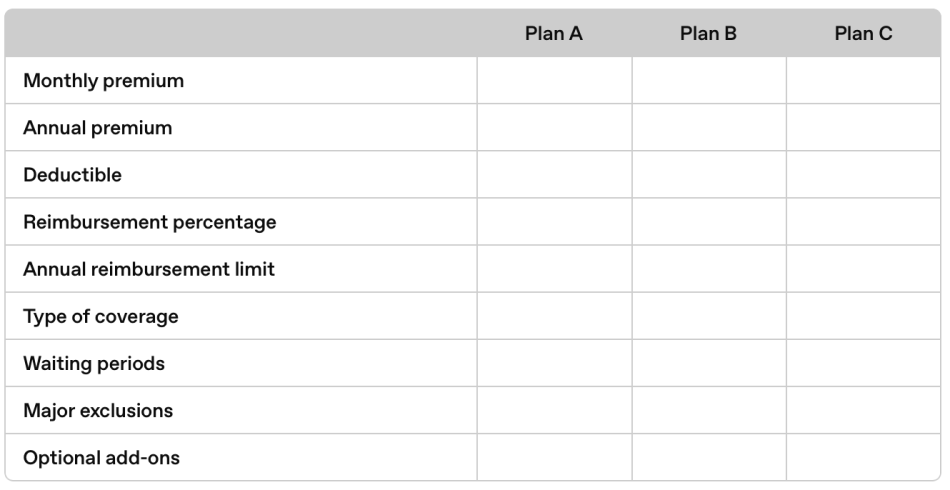
The first practical step once you have quotes is to organize them. Pull up each quote and make note of the following information:
- Monthly premium
- Annual premium
- Deductible
- Reimbursement percentage
- Annual reimbursement limit
- Type of coverage
- Waiting periods
- Major exclusions
- Optional add-ons
Once you have the information side by side, you can get a better idea of what each plan really looks like.
Make Sure You’re Comparing the Same Level of Coverage
The quotes you’re looking at aren’t really comparable if one is accident-only and the other includes accidents and illnesses. Accident-only coverage pays for injuries, like broken bones and bite wounds, but excludes illness entirely, including cancer, infections, and chronic conditions. Accident-and-illness coverage, the most common type, covers both.
Because accident-only plans are considerably cheaper, they will usually look like the better deal compared to plans that cover both accidents and illnesses. The same logic applies to wellness and preventive add-ons, which bundle routine care such as vaccinations and annual exams into the price; a quote that includes extras will naturally cost more.
Compare the Deductible and Reimbursement Rate Together
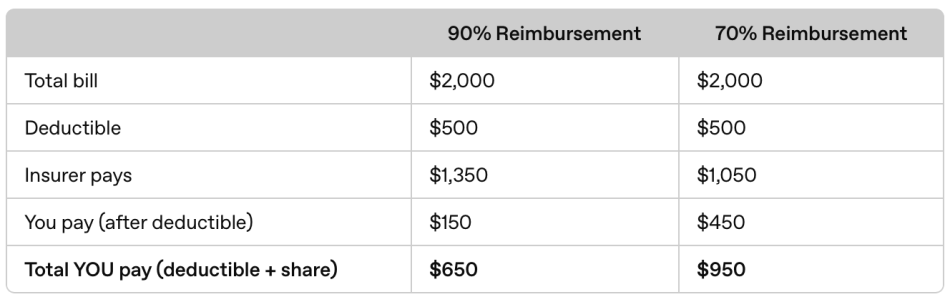
The deductible is the amount you pay out of your own pocket before the insurance company begins reimbursing you. If your plan has a $500 deductible and your dog’s treatment costs $2,000 in covered charges, you pay the first $500, and the insurance pays its share of the remaining $1,500, which is determined by the reimbursement percentage.
For example, if your reimbursement rate is 90%, insurance would pay $1,350 of that remaining $1,500, leaving you responsible for $150 plus the deductible. A 70% reimbursement rate would mean $1,050 is covered, and you pay the rest.
Pay attention as well to how the deductible works. Most plans use an annual deductible, which you meet once per policy year, regardless of how many conditions your pet develops. Some insurers instead use a per-condition deductible, which must be met separately for each new illness or injury.
A per-condition structure can cost far more over the year if your dog develops multiple health problems, even if the deductible seems smaller. These two numbers should be evaluated together rather than separately, because they interact so much.
A low deductible paired with 70% reimbursement can leave you paying more on a large claim than a higher deductible paired with 90% reimbursement. The only way to see which combination protects you better is to run the math on a realistic vet bill.
Look Closely at the Annual Coverage Limit

The annual coverage limit is the ceiling on what the insurer will pay out in a policy year, and it is one of the most important numbers in any quote. Common structures include:
- A $5,000 annual limit
- A $10,000 annual limit
- A $20,000 annual limit
- Unlimited annual reimbursement
Lower limits keep premiums down, which is why budget-priced quotes so often carry them. Annual limits become critically important when something serious happens; major surgery, cancer treatment, management of a chronic disease, or an emergency hospitalization can each run into the tens of thousands potentially.
Once the limit is reached, every additional dollar of care that year comes out of your pocket, regardless of your reimbursement percentage.
Read the Exclusions Carefully
Exclusions are where similar-looking plans can actually become quite different, and they determine what you will never be reimbursed for, no matter how much you pay. Common exclusions and limitations include:
- Pre-existing conditions, which are anything diagnosed or treated before coverage began
- Symptoms that began before enrollment; even without a formal diagnosis, earlier signs of a condition can render it pre-existing
- Bilateral conditions; if one knee, hip, or eye was affected before enrollment, the other side may be excluded too
- Breed-specific restrictions, which includes limits on conditions common to certain breeds
- Elective or cosmetic procedures, such as tail docking, ear cropping, or declawing
- Breeding and pregnancy costs, including pregnancy complications
- Routine and preventive care, like vaccines, checkups, and parasite prevention, unless a wellness add-on specifically includes them
- Dental exclusions; many plans limit dental coverage to accidents, excluding dental illness or cleanings
To find these terms, review the actual sample policy, not just the marketing page.
Compare What Each Plan Actually Covers
Exclusions tell you what a plan will not pay for; it’s just as important to compare what each plan actually covers. When reviewing each plan’s coverage, check whether it includes:
- Hereditary and congenital conditions, such as hip dysplasia or heart defects, which some plans cover fully and others restrict
- Chronic condition coverage, confirming that a condition diagnosed this year, like diabetes or allergies, remains covered when your plan renews
- Exam and consultation fees; some plans reimburse the visit itself; others pay only for treatment
- Prescription medications and prescription food, as ongoing medications can be a major cost for chronic conditions
- Diagnostics, like bloodwork, X-rays, MRIs, and ultrasounds, which drive much of a large vet bill
- Alternative and rehabilitative care, such as hydrotherapy, acupuncture, or physical therapy
- Behavioral therapy, which is increasingly offered, but far from universal
A plan that covers all of these at a higher premium may deliver far more value than a cheaper plan that doesn’t cover them.
Compare Waiting Periods

A policy does not necessarily begin covering everything the day it starts. Different types of coverage may begin at different times, and these waiting periods can vary quite a bit between insurance companies. When comparing plans, look at:
- The accident waiting period, which is often short, sometimes just a few days
- The illness waiting period, commonly around two weeks
- Orthopedic or cruciate ligament waiting periods, which can be anywhere from 30 days to a few months, depending on the insurer
- Any state-specific differences, since some states regulate or limit waiting periods
Orthopedic waiting periods are worth paying attention to for certain breeds and for pets with known joint risks. If you own a breed prone to hip dysplasia or cruciate ligament injuries, a plan with a one- or two-month orthopedic waiting period offers very different protection than one that covers those conditions after 14 days.
Think About How You’ll Actually Get Reimbursed
Two plans with identical coverage can feel very different when it comes time to file a claim, so it is worth comparing the logistics before making a decision. Some important questions are:
- Do you pay the veterinarian first and wait for reimbursement, or does the insurer pay the veterinarian directly?
- How are claims submitted: through an app, an online portal, email, or paper forms?
- What documentation is required, such as itemized invoices or full medical records?
- Are exam fees included in the reimbursable amount, or excluded from it?
Most pet insurance works on a reimbursement model, meaning you cover the full cost at the clinic and the insurer pays you back days or weeks later. For some owners, that gap is a non-issue; for others, it is the single most important feature to compare, and an insurer that pays the vet directly may be worth a higher premium.
Look Beyond the Price You’re Quoted Today
It’s tempting to just focus on the monthly cost you see for a pet insurance plan, but today’s quote is really just a starting point. With pet insurance, the price you pay now probably won’t stay the same year after year. In fact, two similar-looking plans can start at nearly identical prices and end up with very different costs just a few years down the line.
One of the biggest factors is your pet’s age. Premiums almost always increase each year as your pet gets older because covering an older pet is more expensive for the insurer. Plus, your company can raise rates for other reasons, such as when vet care generally costs more in your area or when their expenses and the number of claims increase.
Before you sign up, spend a few minutes checking for transparency about price increases. Some insurers share “sample” monthly premiums for different ages so you can see what to expect in the future. Or, review websites often talk about how much premiums go up at renewal.
Also, don’t hesitate to reach out and ask whether making a claim could raise your specific price. If you’re planning to cover more than one pet, ask any company you’re considering whether there are discounts for multiple policies. At the end of the day, you’re not looking for a deal just for this year, but for your pet’s lifetime.
Use a Comparison Site to Narrow the Options

Comparing insurers one at a time by opening each website, generating a quote, and hunting down the policy details can take hours, and it’s easy to lose track of which plan offered what and at what price. A comparison platform can make this considerably easier by putting providers and plan information in one place, making it easier to build a shortlist worth investigating further.
BestMoney and U.S. News are two examples. They are financial comparison platforms that, among other product categories, compare pet insurance options. A platform like this can be very useful throughout this process by helping consumers research providers, compare options side by side, narrow the options down to a more manageable list, put all plan information into a simpler format, and provide regularly updated reviews and rankings that reflect current offerings.
The site lets you compare big-picture details like coverage options, pricing, plan flexibility, claims processes, and customer service, which helps you quickly zero in on a few plans that seem like a good fit for you and your pet. If a couple of policies catch your attention, you can then dig deeper using individual reviews.
These outline what you can expect regarding reimbursements, deductibles, additional plan features, and the claims process. Top comparison sites also share practical guides for more complex situations, such as finding coverage for older pets, pets with pre-existing conditions, or multi-pet households.
It’s worth understanding how these platforms work. BestMoney, for example, is free to consumers and supported by advertisements, and partner compensation may influence product placement and rankings. A comparison tool can reduce the amount of research you have to do from scratch, but it should not replace reading the actual policy. Use it to narrow the field, then verify the deductible, exclusions, waiting periods, and coverage terms directly.
Other Ways to Research and Compare Plans
A comparison site is one tool you can use to compare, but there are other ways as well.
- Gathering quotes directly from insurers’ websites, which ensures you are seeing current pricing and plan configurations
- Consulting other comparison platforms, such as Pawlicy Advisor, which focuses specifically on pet insurance
- Reading independent reviews from established financial or insurance publishers, such as NerdWallet, which evaluate insurers against their own criteria
- Asking your veterinarian about the types of coverage that may matter for your particular pet
Whichever method you use, make sure you pay attention to the important criteria and read the fine print carefully.
How Do You Compare Two Pet Insurance Plans That Still Look Similar?

Sometimes, after all your research, you’re unable to choose between two pet insurance plans with nearly identical coverage and price tags. When that happens, a closer look at the details can help you figure out which one will actually serve you and your pet best if you ever need to use it.
Check the Insurer’s Claims Reputation
Start with the claims experience, because the only time your policy actually matters is when you file a claim. Independent reviews and customer feedback can tell you how quickly each insurer processes claims, how often claims are denied or disputed, and how the company treats policyholders when something goes wrong.
Look for patterns rather than isolated complaints; every insurer has unhappy customers, but repeated reports of slow payments, aggressive pre-existing condition determinations, or records requests that drag on for weeks are important to consider.
Weigh the Practical Conveniences
Day-to-day features are important but may not appear on a comparison chart. Some things worth comparing include:
- Direct vet payment, which eliminates the need to front large bills
- A well-designed app or portal for submitting claims and tracking their status
- 24/7 vet telehealth lines
- Waiting-period waivers or reductions with a recent veterinary exam
- Multi-pet discounts if you have or plan to have more than one animal
None of these alone should make the decision for you, but when two policies are very similar, it’s worth looking into some of them.
Consider the Company’s Pricing Track Record
Some insurers are known for steep renewal increases as pets age, while others raise rates more gradually. Independent reviews and long-term customer feedback often reveal these patterns, and some insurers publish sample pricing across ages.
Look at Who Stands Behind the Policy
Pet insurance brands are not always the companies that actually pay the claims. Many plans are sold by one company but underwritten by another, and the underwriter’s financial strength and history matter. The underwriter should be disclosed in the sample policy and usually in the website’s fine print.
While you are there, check how long the brand has offered pet insurance and whether it has a history of discontinuing plans or transferring policyholders between underwriters, which can bring changes in terms. Between two similar plans, an established underwriter with a stable history is an advantage.
Test the Customer Service Before You Buy
You can learn a surprising amount about an insurer before spending a dollar. Call or chat with each company’s support line and ask a couple of questions, such as how the deductible applies, whether your pet’s breed has any restrictions, and how to submit a claim.
Note how long it takes to reach a person, whether the answers are clear and consistent with the written policy, and whether the representative pressures you or informs you. This can be time-intensive, but it is generally worthwhile before making such an important decision.
Run a Final Scenario Test
Finally, make the comparison concrete. Imagine the specific situations your pet is most likely to face, like an orthopedic injury that commonly occurs in the breed of dog you have, a swallowed object, or an unfortunate cancer diagnosis, and walk each plan through them step by step. As you go through these scenario tests, pay attention to what’s actually covered, how out-of-pocket costs might add up, any potential hurdles in the claims process, and whether you’d hit any annual or condition-specific limits.
By envisioning real-life emergencies and how both plans would support you, you’ll feel far more confident that you’re making the best choice for your pet’s health and your budget.
Compare Plans the Right Way and Choose with Confidence

Comparing pet insurance plans takes more than lining up monthly premiums. The plans that look cheapest at first glance can carry lower limits, longer waiting periods, or exclusions that only reveal themselves when a big vet bill arrives. By putting your quotes side by side, matching coverage levels, weighing the deductible and reimbursement rate together, and reading the exclusions and waiting periods carefully, you can see what each plan actually offers, and what you’re really paying for.
Tools like BestMoney can speed up the research and help you build a shortlist, but the final step always includes reading the current policy terms directly from the insurer before you enroll. When you put in the effort up front, you can sign up knowing that if your pet ever has their worst day, you’ve already chosen the plan that will handle it best.