Whether you are looking to get a mortgage to buy your first home, taking out a loan to buy that car you know you’ve been wanting, or juggling personal credit card debt, you’ll want to watch out for these key things.
Interest Rate vs. APR: What to Know

Interest rates and APR are not the same thing, and lenders can take advantage of the fact that you don’t know the difference so that you’ll take a loan with them.
I’ve witnessed it firsthand when going to a car dealership and the sales rep keeps mentioning a 6% interest rate, but then when all is said and done, you are effectively paying 8% to 10%.
No matter what kind of loan you are trying to get, lenders typically charge some kind of fee, whether administrative or an origination fee (to kick off the loan). These fees are how institutions, lenders, and banks make more money on top of the interest paid. APR accounts for those fees, while interest rate ignores them.
So let’s create a very simple example:
Let’s assume you are taking a 4-year $100K loan at a fixed 6% interest rate. This would calculate to $6K (or $500 a month) paid in interest per year. Note that the actual math depends on how often interest compounds and how your payments are structured.
Comparatively, let’s assume the lender is charging $5K to originate the loan. APR would calculate the $6K paid in interest plus the $5K in fees divided by the term length (in this case 4 years). This means you’d effectively be paying an additional $1,250 per year for this loan, bringing your true APR to 7.25%.
Here’s how that breaks down side by side:
| Interest Rate Only | With APR (Includes Fees) | |
| Loan Amount | $100,000 | $100,000 |
| Stated Rate | 6.00% | 6.00% |
| Origination Fee | Not factored in | $5,000 (5%) |
| Annual Interest Cost | $6,000 / year | $6,000 / year |
| Annual Fee Cost | $0 | $1,250 / year |
| True Annual Cost | $6,000 / year | $7,250 / year |
| Effective Rate | 6.00% | 7.25% APR |
Additionally, depending on how your lender charges the origination fee, you could end up paying more interest on the origination fee itself.
This varies depending on the lender, but most lenders deduct it from the loan balance, which would mean instead of getting the full $100K you asked for, you’ll get $95K and pay interest on the full amount.
Separately, they could also add it to the loan balance which means you borrow slightly more than originally planned (in this case, your true loan amount would be $105K).
So if you are given different offers from a couple different lenders, and one has the origination fee waived with a slightly higher interest rate, and the other has the lower interest rate but a 5% origination fee, it is 100% worth calculating or asking for the APR.
Federal law does require lenders to disclose the APR, yay Truth in Lending Act (TILA), so make sure you use this instead of relying solely on the interest rate. APR tells the full picture of what you’re paying.
The Problem With Shopping Lender by Lender
Before we get into how to choose between lenders, I want to flag something that tripped me up early on.
When I first started comparing loan offers, I was going lender by lender, filling out forms on different websites, waiting to hear back, and trying to keep track of everything in my iPhone Notes app.
The issue is each lender shows you rates differently, some lead with monthly payments, some lead with interest rate, and some bury the APR in a footnote.
It genuinely gets so confusing and sucks up all your time.
Taking Advantage of Comparison Platforms
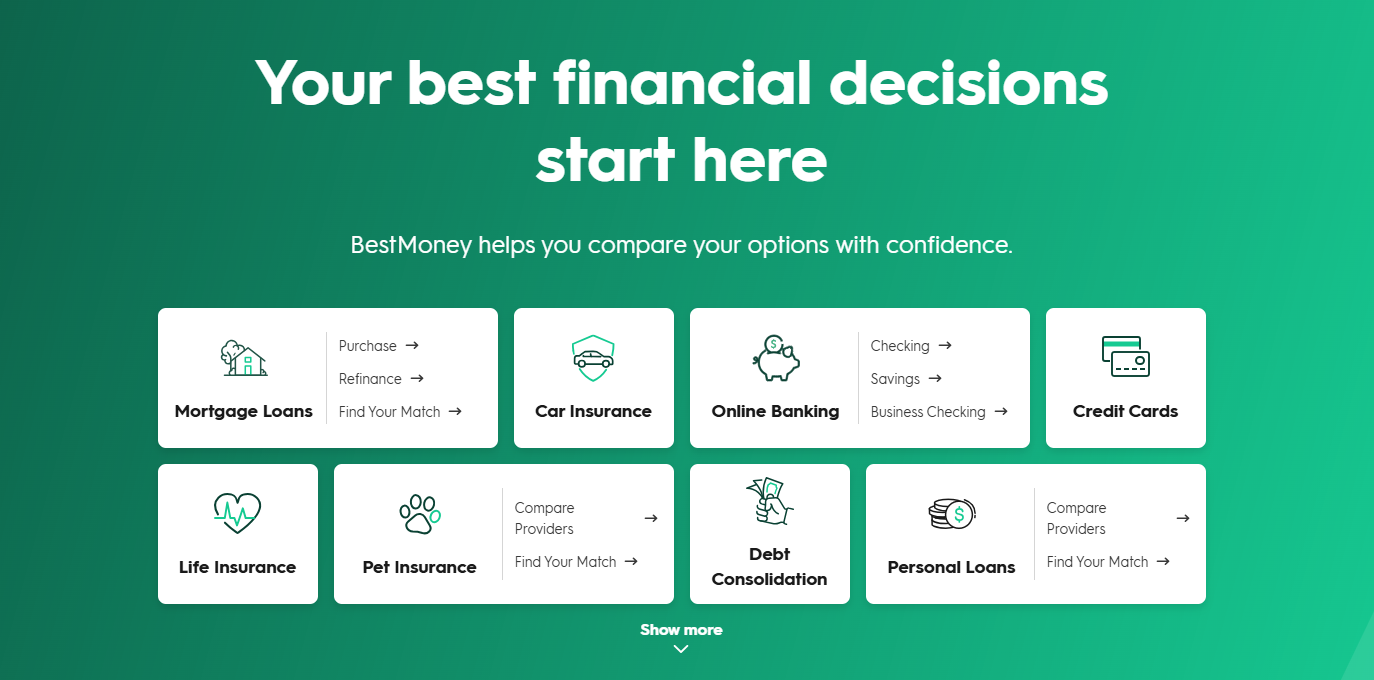
That’s why I started using comparison platforms, instead.
Basically, instead of visiting each lender individually, you go to one place that surfaces multiple options side by side.
One that I’ve found useful is BestMoney. It’s a free, ad-supported platform that pulls together personal loan options from different lenders and lets you filter by term length, loan amount, and credit profile.
It also has editorial breakdowns that explain the differences between products, which helped me understand what I was actually looking at when the terminology felt unfamiliar.
Quick Note on How These Platforms Work:
BestMoney (and others like it) make money through advertising partnerships with lenders. That can influence which lenders appear and where they’re placed.
This is standard across comparison sites. BestMoney does disclose this, which is the right move.
My advice: use it as a starting point to see what’s out there, get a feel for rates, and narrow your options. Then go verify the terms directly with whatever lender you’re leaning toward.
Think of it like using Zillow to scope out neighborhoods before actually touring houses.
How to Choose Between Lenders and Get the Best Rate Possible

Now that you know what APR means and have a way to survey the market, let’s talk about the foundation of everything: your credit score.
These two words might cause some people to flinch, but it’s super important to understand your credit score and how to prevent negative impacts to it while shopping for loans.
Without getting too deep into it (this could be its own article), your credit score is a formula derived from five buckets:
- Payment history (35%)
- Credit utilization (30%)
- Length of credit history (15%)
- Credit mix (10%)
- New credit (10%)
The main thing you need to know for loan shopping: your score directly affects the rate you’ll pay.
For context:
- A FICO range of 750–850 (considered very good to exceptional) would land you at about 6.1% APR on a standard mortgage.
- A 700–759 credit score would push APR to around 6.6%.
- With a score lower than 639, you’re paying above 8% APR.
That’s a 43% increase in actual interest paid. On a $400K 30-year loan, that’s the difference between about $473K in total interest and $674K. Over $200K more just because of where your credit score sits.
If your score needs work, the biggest levers are:
- Don’t open new accounts before applying
- Pay down credit card balances before your statement closes (this directly reduces your utilization ratio)
- Always pay on time
Give yourself at least 6 months to a year before a big loan to get your score in shape.
Once you know where your score stands, the first thing you’ll want to do is get prequalified with a variety of different lenders so you can compare prices. This is where a lot of people mess up. They jump straight to applying, which triggers a hard credit inquiry and can ding your score. That’s the opposite of what you want when you’re trying to get the best rate.
Prequalification is different. Most reputable lenders now offer it through what’s called a soft credit pull. This lets the lender check your credit profile and give you an estimated rate and loan terms without affecting your credit score.
Your credit report records the inquiry, but it’s invisible to other lenders and doesn’t factor into your score. The key is to prequalify with a few different lenders (this is where a platform like BestMoney saves you time) and then compare the offers.
How to Evaluate Offers From Multiple Lenders

Once you have multiple offers in front of you, here’s how to actually compare them:
Align Your Offers
You’ll want to level the playing field to the best of your ability. This means checking the term length and ensuring you are comparing apples to apples.
When going through this process, I found myself going into a rabbit hole figuring out whether it was better to go with a 30 year term vs a 15 year term. This caused me to begin comparing too many things at once and overwhelming myself with options.
Stick to one term length to make things easier for you.
Quick breakdown: a lower term means higher monthly payments but less interest paid over the loan. Higher term means lower monthly payments but more interest paid over the loan.
Check APR, Not Interest Rate
We talked about this earlier, but it’s imperative that you account for fees, and the best way to do that is by looking at the APR. I can’t stress this enough.
Two lenders can quote you the same interest rate and cost you wildly different amounts because of what they’re charging on top.
Watch Out for Prepayment Penalties
This is a good one to check in case you ever want to pay the loan off earlier (maybe you finally win the lottery).
Some lenders charge a fee to do this, so if you plan on paying more than the monthly payment to pay it off sooner, you may want to opt for a loan that doesn’t charge these fees.
I almost overlooked this when I was shopping around and I’m glad I didn’t.
Check the Total Repayment Amount
Multiply your monthly payment by the number of months, then add any pesky fees on top.
That way you can see the true cost of each loan and compare the absolute cost of getting that new car or house.
This is the number that actually matters at the end of the day.
Always Read the Fine Print
Some lenders fund within a day or two, while others might take a week or more. If you need the money quickly, you’ll want to keep this in consideration.
Also check whether the lender reports to all three credit bureaus (Experian, Equifax, TransUnion) as consistent reporting helps you build credit history and credit mix, which is a secondary benefit of taking out a personal loan and repaying it on time.
Where Should You Go From Here?

If you’ve read this ‘Personal Loan Rates Explained’ so far, you already know more than most people walking into a lender’s office.
The difference between a good rate and a mediocre one adds up fast and can make or break your financial situation. Just 1% on a $500K 30-year loan can cost you an additional $119K in interest. That’s enough to buy a Porsche or put a downpayment on a half a million dollar house.
Here’s what I’d do if I were starting from scratch today: check your credit score, give yourself time to improve it if needed, then head to BestMoney or a similar comparison platform to see what rates look like for your situation. Prequalify with a few lenders using soft pulls, line up the APRs side by side, and run the total repayment math before committing to anything.
The lending industry benefits when you don’t compare and that extra ten minutes of research is worth more than you think.