If you’ve started shopping for pet insurance, you’ve probably come across a pretty familiar frustration. You request three or four quotes, and each one arrives with a slightly different structure. One plan carries a $250 deductible, another a $500 deductible. One reimburses 90% of eligible costs, another only 70%. Annual limits range from $5,000 to unlimited, and exclusions change based on the company you choose. Optional add-ons make the comparison even more challenging.
The outcome is that you end up spending hours comparing pet insurance plans, unable to come to a conclusion because the numbers you’re trying to compare are monthly premiums that can’t possibly give you enough information on their own.
A $35-per-month plan cannot be meaningfully compared with a $55-per-month plan until you understand what each one actually covers. The cheaper plan may leave you exposed to thousands of dollars in veterinary bills, or the more expensive plan may include benefits your pet is unlikely to ever use.
This ‘How To Compare Pet Insurance Plans’ article explains how to put pet insurance plans next to each other and compare them in a way that actually helps you make the right decision. Comparison platforms such as BestMoney can simplify the initial research by gathering quotes and plan summaries in one place. However, the final decision should always involve reviewing the insurer’s current policy terms directly, as published details can change and summaries rarely capture every exclusion.
Start by Putting Your Quotes Side by Side

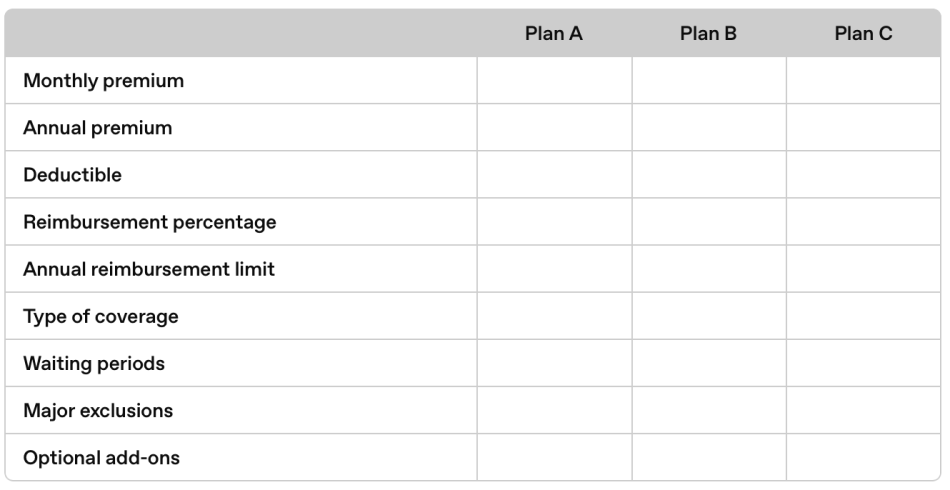
The first practical step once you have quotes is to organize them. Pull up each quote and make note of the following information:
- Monthly premium
- Annual premium
- Deductible
- Reimbursement percentage
- Annual reimbursement limit
- Type of coverage
- Waiting periods
- Major exclusions
- Optional add-ons
Once you have the information side by side, you can get a better idea of what each plan really looks like.
Make Sure You’re Comparing the Same Level of Coverage
The quotes you’re looking at aren’t really comparable if one is accident-only and the other includes accidents and illnesses. Accident-only coverage pays for injuries, like broken bones and bite wounds, but excludes illness entirely, including cancer, infections, and chronic conditions. Accident-and-illness coverage, the most common type, covers both.
Because accident-only plans are considerably cheaper, they will usually look like the better deal compared to plans that cover both accidents and illnesses. The same logic applies to wellness and preventive add-ons, which bundle routine care such as vaccinations and annual exams into the price; a quote that includes extras will naturally cost more.
Compare the Deductible and Reimbursement Rate Together
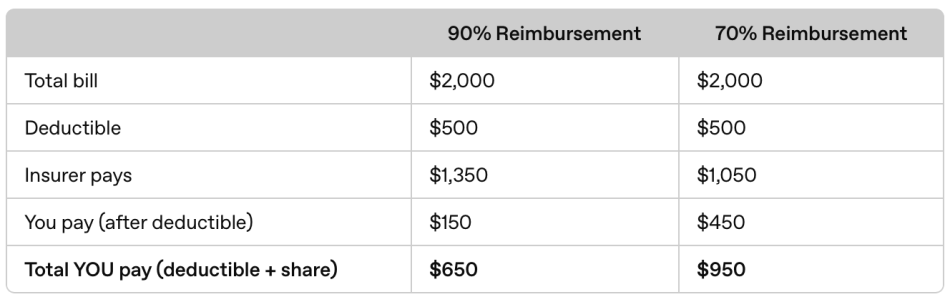
The deductible is the amount you pay out of your own pocket before the insurance company begins reimbursing you. If your plan has a $500 deductible and your dog’s treatment costs $2,000 in covered charges, you pay the first $500, and the insurance pays its share of the remaining $1,500, which is determined by the reimbursement percentage.
For example, if your reimbursement rate is 90%, insurance would pay $1,350 of that remaining $1,500, leaving you responsible for $150 plus the deductible. A 70% reimbursement rate would mean $1,050 is covered, and you pay the rest.
Pay attention as well to how the deductible works. Most plans use an annual deductible, which you meet once per policy year, regardless of how many conditions your pet develops. Some insurers instead use a per-condition deductible, which must be met separately for each new illness or injury.
A per-condition structure can cost far more over the year if your dog develops multiple health problems, even if the deductible seems smaller. These two numbers should be evaluated together rather than separately, because they interact so much.
A low deductible paired with 70% reimbursement can leave you paying more on a large claim than a higher deductible paired with 90% reimbursement. The only way to see which combination protects you better is to run the math on a realistic vet bill.
Look Closely at the Annual Coverage Limit

The annual coverage limit is the ceiling on what the insurer will pay out in a policy year, and it is one of the most important numbers in any quote. Common structures include:
- A $5,000 annual limit
- A $10,000 annual limit
- A $20,000 annual limit
- Unlimited annual reimbursement
Lower limits keep premiums down, which is why budget-priced quotes so often carry them. Annual limits become critically important when something serious happens; major surgery, cancer treatment, management of a chronic disease, or an emergency hospitalization can each run into the tens of thousands potentially.
Once the limit is reached, every additional dollar of care that year comes out of your pocket, regardless of your reimbursement percentage.
Read the Exclusions Carefully
Exclusions are where similar-looking plans can actually become quite different, and they determine what you will never be reimbursed for, no matter how much you pay. Common exclusions and limitations include:
- Pre-existing conditions, which are anything diagnosed or treated before coverage began
- Symptoms that began before enrollment; even without a formal diagnosis, earlier signs of a condition can render it pre-existing
- Bilateral conditions; if one knee, hip, or eye was affected before enrollment, the other side may be excluded too
- Breed-specific restrictions, which includes limits on conditions common to certain breeds
- Elective or cosmetic procedures, such as tail docking, ear cropping, or declawing
- Breeding and pregnancy costs, including pregnancy complications
- Routine and preventive care, like vaccines, checkups, and parasite prevention, unless a wellness add-on specifically includes them
- Dental exclusions; many plans limit dental coverage to accidents, excluding dental illness or cleanings
To find these terms, review the actual sample policy, not just the marketing page.
Compare What Each Plan Actually Covers
Exclusions tell you what a plan will not pay for; it’s just as important to compare what each plan actually covers. When reviewing each plan’s coverage, check whether it includes:
- Hereditary and congenital conditions, such as hip dysplasia or heart defects, which some plans cover fully and others restrict
- Chronic condition coverage, confirming that a condition diagnosed this year, like diabetes or allergies, remains covered when your plan renews
- Exam and consultation fees; some plans reimburse the visit itself; others pay only for treatment
- Prescription medications and prescription food, as ongoing medications can be a major cost for chronic conditions
- Diagnostics, like bloodwork, X-rays, MRIs, and ultrasounds, which drive much of a large vet bill
- Alternative and rehabilitative care, such as hydrotherapy, acupuncture, or physical therapy
- Behavioral therapy, which is increasingly offered, but far from universal
A plan that covers all of these at a higher premium may deliver far more value than a cheaper plan that doesn’t cover them.
Compare Waiting Periods

A policy does not necessarily begin covering everything the day it starts. Different types of coverage may begin at different times, and these waiting periods can vary quite a bit between insurance companies. When comparing plans, look at:
- The accident waiting period, which is often short, sometimes just a few days
- The illness waiting period, commonly around two weeks
- Orthopedic or cruciate ligament waiting periods, which can be anywhere from 30 days to a few months, depending on the insurer
- Any state-specific differences, since some states regulate or limit waiting periods
Orthopedic waiting periods are worth paying attention to for